

 English
 русский
 عربى


Industry News
Wire EDM Machine Price: 7 Factors That Affect the Cost
2026-10-20
A wire EDM machine is quoted, not listed. Two machines with the same table size can differ by more than double once the drive system, accuracy chain, taper range and controller are specified. Here is what actually moves the price, and what you can do about it.
Most buyers start a wire EDM search with one number in mind: a price. What they receive instead is a set of quotations that are hard to compare, because no two suppliers describe the same machine in the same terms. One quote names a table size and a cutting thickness; another names a table size, a drive type, a pass strategy, a taper angle at a stated height, a controller model and an electrical configuration.
The second quote is not necessarily more expensive. It is simply more specific, and specificity is what a purchase decision needs.
Wire EDM machine price is driven by seven factors, and six of them are decisions the buyer makes, not costs the manufacturer imposes. This guide works through each one: what changes, why it changes the price, and where the money is genuinely well spent. It is written for tool room managers, process engineers and purchasing teams comparing wire EDM machine manufacturers rather than shopping for the lowest number in an inbox.
Why there is no price list in this article. POOSN does not publish fixed machine prices, because a wire EDM quotation is assembled from the work envelope, the accuracy class, the taper requirement, the controller and the destination, and because on a machine that lasts fifteen years, the purchase price is the smallest part of the cost of ownership. What this article does instead is show you exactly which variables a quotation is built from, so you can tell a well-specified quote from a cheap one.
Content
- 1 1. Why Do Wire EDM Machine Prices Vary?
- 2 2. High-Speed vs. Medium-Speed Wire EDM: What Is the Cost Difference?
- 3 3. How Worktable Size and Cutting Thickness Affect Price
- 4 4. How Accuracy and Surface Finish Affect Machine Cost
- 5 5. Does Taper Cutting Increase the Cost?
- 6 6. How Controller, Software and Electrical Configuration Affect Price
- 7 7. What Other Costs Should Buyers Consider?
- 8 How to Get an Accurate Wire EDM Machine Quotation
- 9 Frequently Asked Questions About Wire EDM Machine Price
- 9.1 How much does a wire EDM machine cost?
- 9.2 Is a medium-speed wire EDM machine worth the extra cost over a high-speed machine?
- 9.3 Does a thicker cutting capacity really change the machine price?
- 9.4 Does ±45° taper cost much more than ±6°?
- 9.5 Can the machine be configured for 220 V, 440 V or 60 Hz?
- 9.6 What should I verify before comparing two wire EDM quotations?
- 10 Where to Go Next
1. Why Do Wire EDM Machine Prices Vary?
Two wire EDM machines can share a worktable, a colour and a catalogue page and still be completely different products. The gap comes from six physical differences, and one commercial one.
Where the price difference actually sits
| Variable | What changes on the machine | Effect on price |
|---|---|---|
| Machine class | Single-pass high-speed platform versus multi-pass medium-speed platform: wire drive, tension control, controller capability | Largest single factor |
| Work envelope | Castings, guide rail and ball screw length, column stiffness, tank volume, flushing pump capacity, machine mass | Rises steeply above mid-size envelopes |
| Accuracy chain | Ground linear guides versus sliding guides, ball screw grade, stepper versus closed-loop AC servo, glass scale feedback, calibration and inspection depth | Moderate to large, and invisible in a photo |
| Taper capability | U/V stroke, dedicated taper head, tension and flushing behaviour at angle | Moderate for ±6°, significant for ±30–45° |
| Control and electrical | Controller model, software and file support, voltage / phase / frequency configuration, certification package | Small to moderate, easy to under-specify |
| Commercial scope | Packing, freight terms, installation, training, warranty, spare parts commitment, documentation language | Often 10–20% of the delivered cost |
| Supplier type | Factory selling direct versus trading company reselling the same machine | Changes who answers the phone in year three |
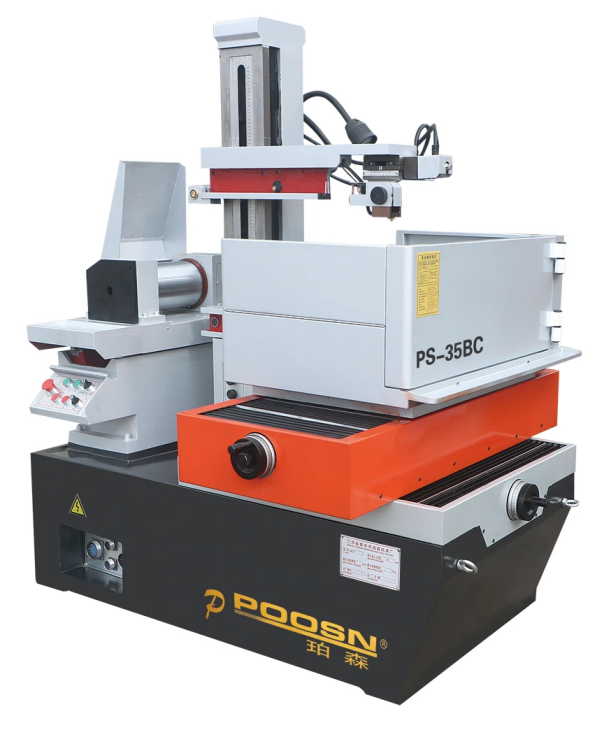
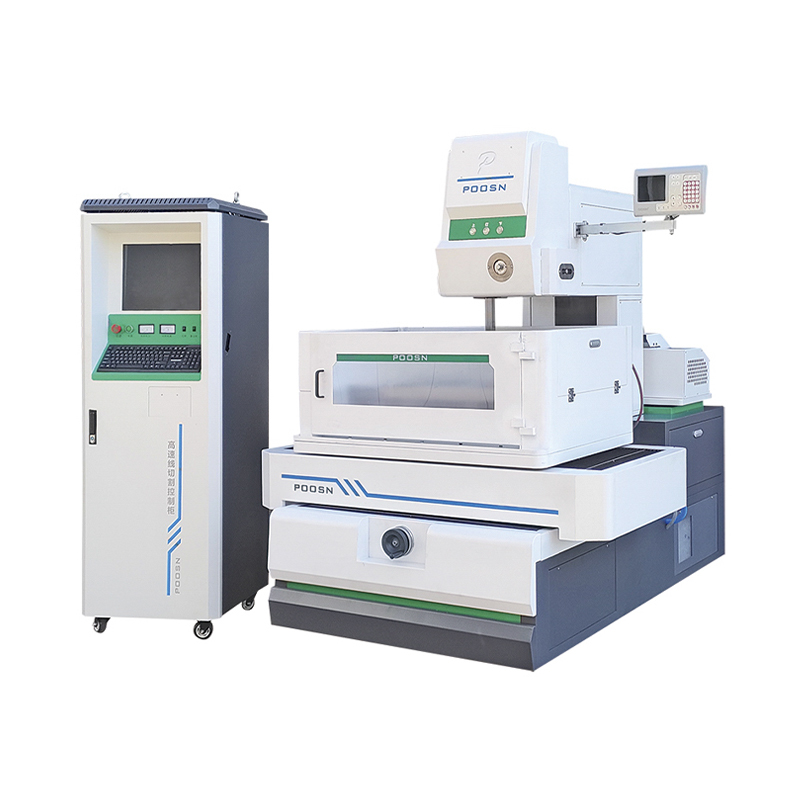
A concrete example makes the point. In the POOSN range, the DK7745F high-speed machine and the PSC45C medium-speed machine cover a broadly similar work area: 450 × 650 mm against 450 × 600 mm of X/Y travel. The DK7745F weighs 1,050 kg. The PSC45C weighs 2,000 kg.
That mass is not decoration. It is the casting section, the guideway support and the frame stiffness that let the medium-speed platform run multiple cutting passes and hold a finer surface. A buyer comparing these two machines on travel size alone is comparing an envelope, not a capability.
2. High-Speed vs. Medium-Speed Wire EDM: What Is the Cost Difference?
A high-speed wire EDM machine and a medium-speed wire EDM machine are built for different jobs, and the cost difference is a consequence of that, not a marketing tier. The question to settle before comparing prices is which class your work actually sits in.
The high-speed platform: DK77 Series
The DK77 Series is a single-pass, reciprocating-wire high-speed machine. Three models cover 350 × 450 mm, 450 × 550 mm and 450 × 650 mm of X/Y travel, all rated for 450 mm maximum cutting thickness, all with 60 × 60 mm U/V travel and ±6°/80 mm taper, with worktable loads from 200 kg to 300 kg.
Its economics are straightforward: the lowest cost per cut on general tooling, brackets, shims, simple punches and roughing work where the tolerance band is loose. What it does not do is deliver a fine finish in one pass, and buying a high-speed machine for work that needs Ra 0.8–1.2 µm is where buyers most often get the calculation wrong.
The medium-speed platform: PSC Series
The PSC Series runs 0.18 mm electrode wire through a wire guide at 1–11 m/s with frequency-controlled feed, four-axis X/Y/U/V linkage, and a multi-pass strategy that reaches Ra ≤ 1.2 µm with cutting efficiency of 10,000–16,000 mm²/h. Processing accuracy is stated at 0.01 mm. X/Y stepper drives are standard; AC servo drives are an option, and that option is one of the price levers discussed in Section 4.
Two models are commonly quoted: PSC45C with 450 × 600 mm travel, 280 mm cutting thickness and 400 kg table load, and PSC50C with 500 × 700 mm travel, 350 mm thickness and 600 kg load.
Platform comparison: specification sheets, POOSN range
| Specification | DK7745F (high-speed) | PSC45C (medium-speed) |
|---|---|---|
| X/Y travel | 450 × 650 mm | 450 × 600 mm |
| Max. cutting thickness | 450 mm | 280 mm |
| Max. worktable load | 300 kg | 400 kg |
| Electrode wire | Reciprocating wire, high-speed platform | Φ0.18 mm through wire guide |
| Wire feed speed | High-speed reciprocating | 1–11 m/s, frequency controlled |
| Cutting strategy | Single pass | Multi-pass to Ra ≤ 1.2 µm |
| Stated accuracy | 0.02 mm (precision) | 0.01 mm (processing accuracy) |
| Axes | X/Y + U/V taper device | X/Y/U/V four-axis linkage |
| Machine weight | 1,050 kg | 2,000 kg |
Buyer's note: “medium-speed” is not a standard. Builders use the term differently. Before you accept it, ask three questions: how many trim passes does the control support, what wire diameter and drive system does the machine use, and what accuracy figure is being quoted: positioning, processing, or a single measured test result? The answer determines whether the extra cost buys capability or only a label.
3. How Worktable Size and Cutting Thickness Affect Price
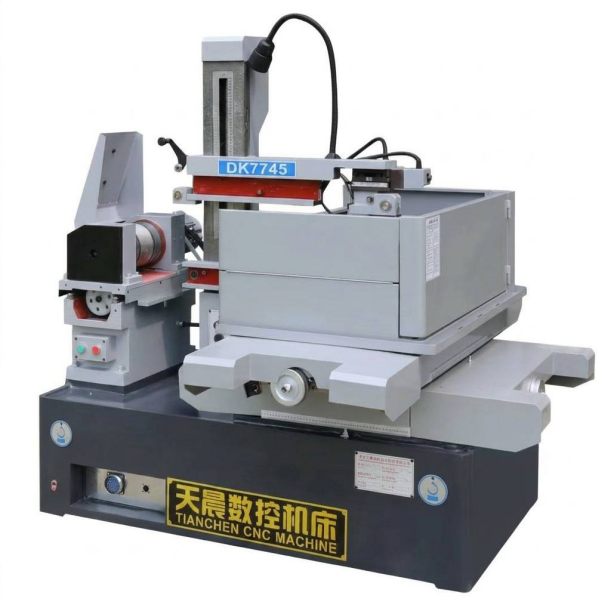
Envelope is the most visible price driver and the easiest one to over-buy. Every extra 100 mm of travel lengthens the guide rails and ball screws, increases the casting, stiffens the column and enlarges the tank and pump set. It also adds mass, which changes what you pay for freight, unloading and floor preparation before the machine ever cuts a part.
Work envelope across the POOSN range
| Series | Model | X/Y travel | Max. thickness | Table load | Machine weight |
|---|---|---|---|---|---|
| DK77 high-speed | DK7735 | 350 × 450 mm | 450 mm | 200 kg | 800 kg |
| DK77 high-speed | DK7745 | 450 × 550 mm | 450 mm | 250 kg | 950 kg |
| DK77 high-speed | DK7745F | 450 × 650 mm | 450 mm | 300 kg | 1,050 kg |
| DK-BC medium-speed | DK35BC | 350 × 450 mm | 300 mm | 250 kg | — |
| DK-BC medium-speed | DK45BC | 450 × 550 mm | 400 mm | 400 kg | — |
| DK-BC medium-speed | DK50BC | 500 × 630 mm | 650 mm | 600 kg | — |
| DK-BC medium-speed | DK60BC | 630 × 800 mm | 800 mm | 800 kg | — |
| PSC medium-speed | PSC45C | 450 × 600 mm | 280 mm | 400 kg | 2,000 kg |
| PSC medium-speed | PSC50C | 500 × 700 mm | 350 mm | 600 kg | 2,200 kg |
| Large-taper | DK55D | 550 × 800 mm | 600 mm | 600 kg | 2,000 kg |
Three things drive the price upward faster than buyers expect:
- Thickness, not just area. A machine rated for 450 mm and one rated for 800 mm are not the same frame. Thick work needs a taller, stiffer column, dual-pump flushing to clear debris from a deep kerf, and a power supply that keeps the recast layer under control. The DK-BC Series spans 300 mm to 800 mm across four models for exactly this reason: the rating is a structural specification, not a brochure figure.
- Mass, and everything that follows it. Going from an 800 kg machine to a 2,200 kg machine changes the export packing, the crane at your door, the floor loading and the freight class. Buyers who budget only the machine price are surprised by the last 10% of the project.
- Part weight versus part size. A 700 × 500 mm part that weighs 550 kg will not run on a machine with a 400 kg table rating, however generous the travel. Check both numbers against the heaviest workpiece in the next two years, not the largest drawing in the archive.
Cost lever: Size the machine for roughly the 90th percentile of the work you actually run, not the single largest part you have ever been asked to quote. Oversizing the envelope raises purchase price, freight, floor space and power draw permanently, while the occasional oversized job can be subcontracted at a known cost.
4. How Accuracy and Surface Finish Affect Machine Cost
Accuracy is the factor buyers pay for most willingly and understand least, because the numbers on different specification sheets do not mean the same thing. Reading them correctly is worth more than any discount you will negotiate.
Three numbers that look alike and are not
| Term | What it measures | Where it appears |
|---|---|---|
| Positioning accuracy | How closely the axes reach a commanded position, usually measured with a laser interferometer on the assembled machine | DK-BC Series: 0.002 mm linear positioning |
| Processing accuracy | What the finished workpiece measures after cutting, including wire lag, spark gap and thermal effects | PSC Series: 0.01 mm |
| Precision (catalogue figure) | A general machine-class figure, with the measurement method often not stated | DK77 Series: 0.02 mm |
A 0.002 mm positioning figure and a 0.02 mm cutting figure describe different things, and neither can be compared with the other. When you receive quotations, ask what was measured, with which instrument, on which machine, and whether the report travels with the unit. A supplier who can answer those four questions is quoting a capability; one who cannot is quoting a habit.
The accuracy chain you are actually buying
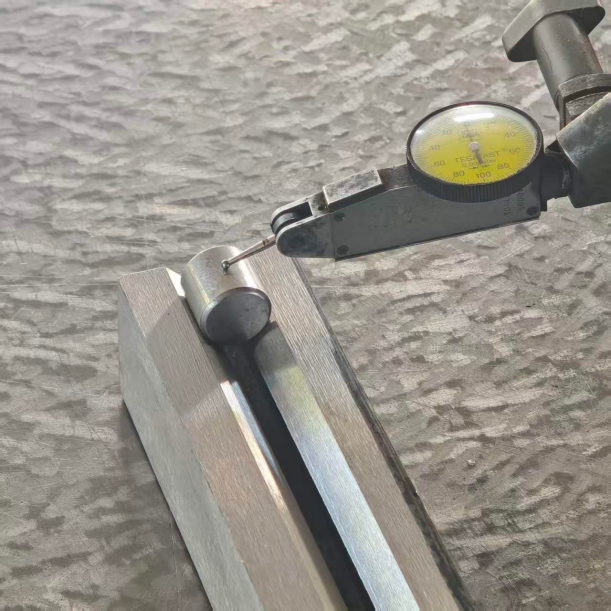
Precision on a wire EDM machine is not one component. It is a chain, and the weakest link sets the result:
- Guideways. Precision-ground linear rails behave differently from sliding guides under load and over years of service, and they are a meaningful share of the machine cost.
- Ball screws. C3-class screws are the grade behind a sub-5 µm positioning claim. Lower grades are cheaper and are usually where a low quotation quietly saves money.
- Drive and feedback. Stepper drives are standard on the PSC platform; AC servo drives and closed-loop glass scale feedback are options. Each step up adds cost and adds repeatability under load and temperature change.
- Structure and stress relief. A thermo-symmetrical cast iron base is naturally aged for six months to relieve internal stress, and the saddle plate goes through 12 hours of tempering, 24 hours of natural cooling and manual stress relief. This is the part of the price that does not appear on any specification sheet, and the part that decides whether the machine still holds tolerance in year five.
- Verification. Laser interferometer positioning measurement and ballbar circularity testing before shipment, with the report issued to the buyer, cost the builder time. They are also the only evidence that the accuracy chain works as assembled.
One more cost-avoidance point: the DK-BC platform is specified to run in a general workshop at 5–40 °C, supported by an independent dielectric cooling circuit and built-in temperature compensation. If a quotation requires a temperature-controlled room to reach its stated tolerance, that room is part of the machine price, and it is usually missing from the comparison.
Surface finish and pass strategy
Finish is bought in passes, and passes are bought in machine time. Reaching Ra 0.8–1.2 µm on a medium-speed machine takes a roughing pass plus one or more trim passes at progressively lower discharge energy. A single-pass high-speed cut does not reach that band at any price.
The cost consequence is easy to state and easy to forget: doubling the number of passes roughly doubles the machine time on that feature, while wire consumption moves far less. So the expensive part of a fine finish is hours, not consumables. If a drawing specifies a fine finish on a surface that never touches another part, you are paying machine hours for nothing, which is why separating functional surfaces from general drawing notes is the highest-return habit in wire EDM purchasing.
Cost lever: Match the accuracy class to the tolerance band you can actually inspect and actually need. Buying 0.002 mm positioning for work held at ±0.02 mm adds cost with no return; buying a two-pass machine for a three-pass requirement adds scrap, hand finishing and delivery risk. The right answer is usually the smaller of the two errors.
5. Does Taper Cutting Increase the Cost?
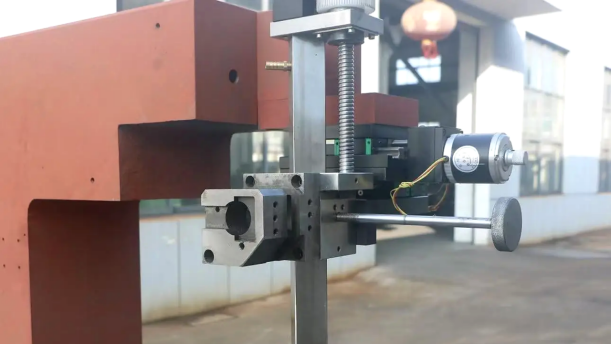
Yes, and the increase is proportionate to how much taper you specify, not a flat premium. Straight-walled work uses a fixed vertical wire path. Tapered work tilts the wire by moving independent U/V axes, which changes what the machine has to control at the same time: wire tension, flushing at the angled surface, and the geometric compensation that keeps the taper true through the part height.
Taper capability by series
| Series | Max. cutting taper | U/V travel | Typical use |
|---|---|---|---|
| DK77 high-speed | ±6° / 80 mm | 60 × 60 mm | Small draft and relief on general tooling |
| DK-BC medium-speed | ±6° / 100 mm as standard; ±30° with optional large-taper wire frame | Confirm per model | Draft on mold and die inserts |
| PSC medium-speed | ±6° / 80 mm | 60 × 60 mm | Precision inserts with modest draft |
| DK55D large-taper | ±30° / 80 mm and ±45° / 80 mm | ±30°: 400 × 400 mm; ±45°: 590 × 590 mm | Deep-angle dies, extrusion and drawing tooling, angular walls |
Three practical points decide whether taper is worth its cost:
- Specify angle, height and deviation together. A machine that holds ±45° at 80 mm may not hold it at 200 mm. The number that decides whether a die assembles cleanly is the maximum deviation at your stated height, and it is the number most often missing from a quotation.
- Large taper is a different machine, not an accessory. On the DK55D, the U/V strokes grow from 60 × 60 mm to 400 × 400 mm at ±30° and 590 × 590 mm at ±45°, with a dedicated taper head so that flushing and tension stay consistent while the wire tilts. That structure is what you are paying for; without it, cut quality on the tapered surface and corner accuracy both degrade.
- Taper adds nothing where the drawing is straight. If there is no draft, relief or angled wall, leave it off the specification. The saving is real and immediate.
6. How Controller, Software and Electrical Configuration Affect Price
The control package is where two quotations of the same machine diverge most quietly, because a controller model number means very little to a buyer who has not operated one.
Control and electrical configuration in the POOSN range
| Item | Standard | Optional / upgrade | Why it matters to cost |
|---|---|---|---|
| Control system | ZHZK-03 on DK-BC and DK55D; X8 / AUTOCUT on the PSC platform | KJZ-07, CHK.CNC.SYS, SN-10000 depending on model | Determines supported passes, file handling and diagnostics |
| Programming | Direct DXF/DWG import, graphical programming, multi-pass presets, auto edge finding and centering | Parameter libraries built per material group | Removes G-code writing and shortens operator ramp-up |
| Drive system | X/Y stepper drives; U/V three-phase stepper drives | X/Y AC servo drives; closed-loop glass scale feedback | Added repeatability under load and temperature |
| Monitoring | Real-time discharge monitoring with adaptive feed to reduce wire breakage | — | Fewer breaks means less downtime, not a lower price |
| Connectivity | USB and LAN program transfer | — | Practical requirement for CAM workflow |
| Power supply | 3-phase 380 V ±10%, 2.5 kVA, max. processing current 6 A | Configuration for other voltages / frequencies | A mismatch here is a transformer or a re-specification |
| Electrical safety / certification | Standard export build | CE / UL certification package (custom option, model-dependent) | Can be a lead-time item as well as a cost item |
| Documentation | Operation manual, electrical drawings, parameter list in English | — | Missing documentation becomes paid support later |
Two configuration questions come up in almost every export order, and both are price-relevant:
- Electrical supply. The standard build is 3-phase 380 V ±10%, 2.5 kVA. If your plant runs 220 V three-phase, 440 V, or 60 Hz, you either specify a configured machine or buy a transformer. Specifying it at the factory is normally the cheaper of the two, and it changes the delivery schedule.
- Options that are really capabilities. AWT (automatic wire threading), a C-axis rotary table, a high-pressure water tank, a linear scale and an enclosure upgrade each change what the machine can do, and each carries its own cost and lead time. Decide which of them your work genuinely needs before the quotation, not after; adding them later costs more than ordering them once.
7. What Other Costs Should Buyers Consider?
The machine is not the delivered project. On an export order, the difference between two quotations is frequently in the scope around the machine rather than in the machine itself, and this is where a wire cut EDM machine cost comparison is usually decided. Every wire EDM machine supplier structures that scope differently, so the only reliable method is to put the same cost lines side by side before you look at the headline figure.
Cost lines to normalize across quotations
| Cost line | What to confirm in writing |
|---|---|
| Packing | Export-worthy case, rust protection, wire frame bracing, container loading plan and whether packing is included or billed separately |
| Inland transport and freight | FOB / CIF / DAP terms, port of loading, whether the quote covers ocean freight, insurance and destination charges |
| Unloading and positioning | Machine mass and lifting points, crane or forklift capacity at your site, floor loading and leveling requirement |
| Installation and commissioning | Whether installation, leveling, calibration and acceptance cutting are included, and by whom at destination |
| Training | Days on site, number of operators, language, and whether programming and parameter training are separate items |
| First consumables | Electrode wire, guide wheels, nozzles, dielectric, resin and filters to run the first weeks of production |
| Spare parts | Recommended spares list, committed lead times for power supply boards and axis drives, and stock held for your model |
| Warranty and support | Warranty period and start point, what is excluded, response route for technical support, and cost of on-site service outside warranty |
| Duty and compliance | HS classification, destination duty, and any certification or labeling your market requires |
| Power and floor works | Supply capacity, cable, breaker, transformer, foundation and coolant handling at your site |
Consumables: the recurring line
A wire EDM machine consumes wire, guides, nozzles, dielectric and resin on a predictable cycle. These are small monthly numbers individually and a real annual figure together, which is why a quotation that is 8% cheaper but locks you into slow or expensive consumables is not cheaper.
| Item | Indicative cost | Service interval / note |
|---|---|---|
| 0.18 mm electrode wire | about USD 3–5 per spool | 40–80 hours of continuous cutting per spool |
| Guide wheels | about USD 15–25 per pair | Inspect monthly on three-shift operation; replace on schedule, not on failure |
| Wire guide nozzles | about USD 8–15 per set | Wear shows up first as a taper error |
| Dielectric (working fluid) | about USD 50–80 per change | Keep conductivity inside the builder's range |
| Resin | about USD 20–40 per change | Consumption rises with water quality and duty cycle |
The comparison that matters
Machine price is a one-time number. Cost per square millimetre of cut is the number that decides whether the investment works:
Cost per cut = (machine depreciation + floor space + power + labour + consumables + scrap and rework) ÷ square millimetres cut per year.
Run that calculation on the two or three quotations in front of you and the ranking often changes. A machine with a two-pass capability and a stable accuracy chain frequently beats a cheaper single-pass machine on cost per cut once scrap, hand finishing and rework are counted, and loses to it on simple loose-tolerance work, where the extra capability is never used.
Cost lever: Ask each supplier for the same three numbers: quoted delivery time, committed spare-part lead time for the components that stop production, and the consumable consumption figure for your material mix. Those three, not the headline price, tell you what year three will cost.
How to Get an Accurate Wire EDM Machine Quotation
Suppliers cannot quote what they cannot see. The fastest route from browsing to a usable quotation is a single message containing the information below. It is also the fastest way to find out whether a supplier actually engineers the answer or simply forwards a price list.
What to include in a quotation request
| # | Input | Why the supplier needs it |
|---|---|---|
| 1 | Maximum workpiece dimensions and weight | Sets work envelope and table load; usually eliminates models first |
| 2 | Material and hardness (e.g. D2 at 60 HRC, SKD11, carbide, Ti-6Al-4V) | Sets pass strategy and discharge parameters |
| 3 | Maximum and typical cutting thickness | Determines frame, flushing and power supply requirement |
| 4 | Tolerance and surface finish that genuinely matter, per surface | Determines machine class and number of passes |
| 5 | Taper angle at a stated part height, if any | Decides between standard ±6° and large-taper platforms |
| 6 | Annual or monthly cutting hours, and shift pattern | Drives machine size, consumable budget and spares recommendation |
| 7 | Plant power: voltage, phase, frequency | Prevents a transformer or a re-build after delivery |
| 8 | Destination port and preferred Incoterm | Makes freight and duty comparable across quotes |
| 9 | Required certification or market compliance | Affects configuration and lead time |
| 10 | Whether a cutting test on your material is required | Replaces a specification argument with a measured result |
With those ten inputs, a manufacturer can recommend a series, name the model, state the pass strategy and give a quotation that another supplier's quotation can actually be compared against. Without them, every quote you receive will be for a different machine, and the cheapest one will be the one with the least in it.
Get a Wire EDM Machine Quotation from POOSN. Looking for a wire EDM machine for your production needs? Tell us your workpiece dimensions, material, required cutting thickness, accuracy requirements and preferred machine configuration. Our team will review your application and recommend a suitable wire EDM machine based on your processing requirements. Contact POOSN to discuss your machine selection and request a quotation.
Frequently Asked Questions About Wire EDM Machine Price
How much does a wire EDM machine cost?There is no single figure, because the price is assembled from the work envelope, the machine class, the accuracy chain, the taper range, the control package and the commercial scope. A single-pass high-speed machine, a multi-pass medium-speed machine and a large-taper machine are three different products at three different price levels, and two machines with the same table size can differ substantially in cost once the drive system and accuracy chain are specified. The reliable way to get a wire EDM machine price is to send your part data and requirements for a configured quotation. |
Is a medium-speed wire EDM machine worth the extra cost over a high-speed machine?It depends on the tolerance band and finish you must hold. If the work is brackets, shims, simple punches and general tooling at a looser tolerance, a high-speed DK77 Series machine delivers the lowest cost per cut and the extra capability goes unused. If the work needs multi-pass cutting to Ra 1.2 µm or better and repeatable accuracy on hardened inserts, the medium-speed platform earns its price back through lower scrap, less hand finishing and fewer re-cuts. |
Does a thicker cutting capacity really change the machine price?Yes, because thickness is a structural rating rather than a number in a brochure. An 800 mm cutting capacity needs a taller and stiffer column, dual-pump flushing to clear a deep kerf, and a power supply that controls the recast layer at high discharge energy. That is why a series like DK-BC spans 300 mm to 800 mm across four models instead of offering one frame with different labels. |
Does ±45° taper cost much more than ±6°?Substantially more, because the U/V strokes grow from 60 × 60 mm to 590 × 590 mm at ±45°, and the machine needs a dedicated taper head so that wire tension and flushing stay controlled while the wire tilts. If your drawings contain no draft, relief or angled wall, specifying ±6°, or none at all, is the cheaper and equally capable choice. |
Can the machine be configured for 220 V, 440 V or 60 Hz?Yes, and it should be decided before the order rather than after delivery. The standard export build is 3-phase 380 V ±10%, 2.5 kVA with 6 A maximum processing current. Tell the supplier your actual supply at the quotation stage; a configured machine is normally cheaper and faster than adding a transformer at your site. |
What should I verify before comparing two wire EDM quotations?Five things: the measured accuracy of the specific unit and the method used to measure it; the number of trim passes the control supports; the committed lead time for spare parts that stop production; the consumable consumption for your material mix; and exactly what the commercial scope includes: packing, freight, installation, training, warranty and documentation language. Normalise those five and the comparison becomes meaningful. |
Where to Go Next
POOSN is the wire EDM brand of Taizhou Xinchengyang Machinery Manufacturing Co., Ltd., a direct manufacturer of high-speed, medium-speed and large-taper wire EDM machines. If you are at the comparison stage, send the part data from the table above and we will come back with a machine recommendation and a configured quotation, not a catalogue page.
| Precision tooling and hardened inserts PSC Series medium-speed wire EDM |
General precision tooling at balanced cost DK-BC Series medium-speed wire EDM |
| Rough cutting and general tooling DK77 Series high-speed wire EDM |
Tapered dies, extrusion and drawing tooling Large-taper (DKD) Series |
| Cutting hardened steel after heat treatment Wire EDM for hardened steel |
Carbide and precision cutting Wire EDM for carbide precision cutting |
| Automotive tooling and tolerances Wire EDM for automotive tooling |
Choosing the electrode wire grade Wire EDM wire selection guide |
| Comparing WEDM with other processes Wire EDM process comparison |
How POOSN builds and tests machines About the POOSN factory |
| A recommendation for your own part Request a quotation |
Published 20 October 2026. Specifications quoted in this article are from current POOSN specification sheets for the DK77, DK-BC, PSC and large-taper ranges, are subject to confirmation, and may change with configuration. Accuracy and performance figures describe machine capability under stated conditions; they are not a guaranteed result for a specific workpiece, material or shop environment, and must not be read as a contractual tolerance.
-
Phone
+86-0523-86268788 +86-13815960366 +86-13912191163Email
[email protected]Address
No. 366, Yusheng Road Jiulong Town, Hailing District Taizhou City, China
Copyright © Taizhou Xinchengyang Machinery Manufacturing Co., Ltd. All Rights Reserved.
Custom edm machine for sale
wholesale edm machine manufacturers
