

 English
 русский
 عربى
عربى

Industry News
Home / News / Industry News / What Makes DKD Large Cutting Taper WEDM a Breakthrough in Precision Machining?
What Makes DKD Large Cutting Taper WEDM a Breakthrough in Precision Machining?
2026-04-07
What Makes DKD Large Cutting Taper WEDM a Breakthrough in Precision Machining?
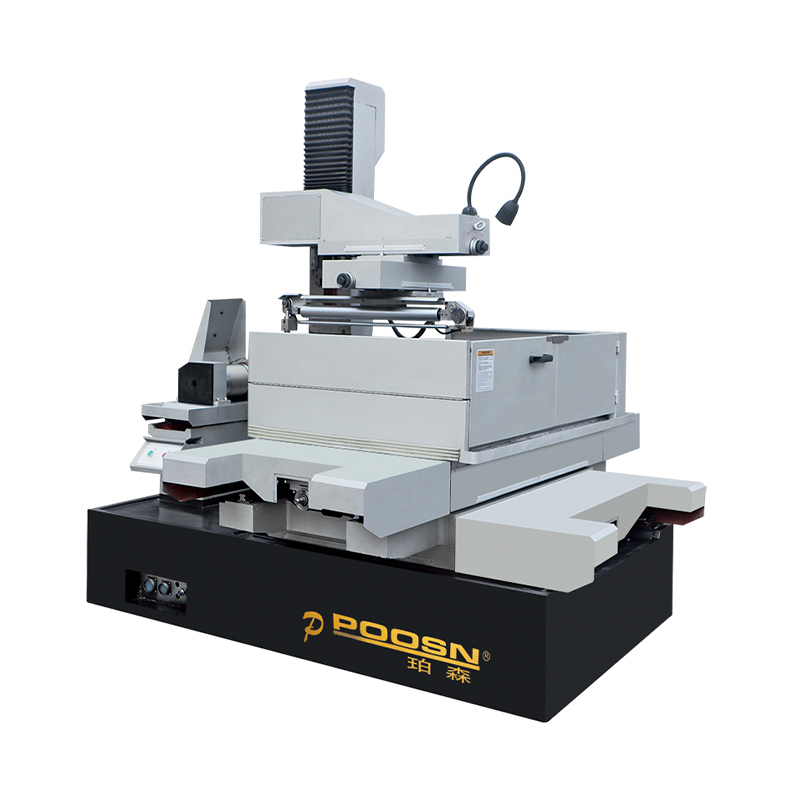
The DKD Large Cutting Taper Wire EDM is a breakthrough in precision machining because it fundamentally expands what wire electrical discharge machining can accomplish in a single setup. It achieves taper angles of up to ±45° on workpieces taller than 500mm, maintains positional accuracy within ±0.003mm across workloads exceeding 3,000kg, and reduces wire breakage by up to 60% through adaptive discharge control — capabilities that no conventional WEDM machine can replicate simultaneously. For manufacturers working in aerospace, heavy die making, extrusion tooling, and large-format mold production, this machine does not simply improve on existing solutions. It makes previously impossible geometries and workpiece scales manufacturable without compromising dimensional integrity or surface quality.
The significance of this cannot be overstated. Precision machining has long faced a fundamental tradeoff: the larger and more geometrically complex a workpiece, the harder it becomes to hold micron-level tolerances. WEDM technology has historically been limited to smaller, thinner workpieces with modest taper requirements. The DKD machine breaks this tradeoff by engineering every subsystem — the machine base, the UV-axis wire guide, the flushing circuit, the pulse generator, and the CNC control — around the specific demands of large, high-taper precision cutting. The result is a machine that delivers fine-wire-EDM-class accuracy at a scale previously associated with much cruder cutting methods.
This article examines each of the technical and practical dimensions that make the DKD Large Cutting Taper WEDM a genuine engineering breakthrough. It covers the machine's structural design, taper cutting system, control intelligence, flushing technology, wire management, application suitability, and total cost of ownership — with specific data and production examples throughout.
The Core Problem: Why Large-Taper WEDM Has Always Been Difficult
To appreciate what the DKD machine achieves, it is worth understanding the engineering challenges that made large-taper WEDM so difficult for so long. Wire EDM works by eroding electrically conductive material using controlled electrical discharges between a thin wire electrode and the workpiece. The wire does not contact the workpiece directly — it is separated by a small gap filled with dielectric fluid, and material removal occurs through the energy released by rapid, precisely timed electrical pulses.
When the wire is held perfectly vertical, this process is well understood and highly controllable. The discharge gap is uniform along the wire's length, flushing is symmetric, and the cut geometry is predictable. But when the wire is tilted to cut a taper, everything changes. The gap geometry becomes asymmetric — the entry point and exit point of the wire are horizontally offset, sometimes by dozens of millimeters on tall workpieces. The discharge distribution along the inclined wire becomes uneven. Flushing effectiveness drops sharply because the dielectric fluid cannot be directed uniformly into an angled cutting zone. Wire tension becomes harder to maintain because the wire path changes shape as the taper angle changes during contouring operations.
On a workpiece that is 100mm tall, a 15° taper creates a horizontal offset of roughly 27mm between wire entry and exit. That is manageable. On a workpiece that is 500mm tall with a 30° taper, the horizontal offset approaches 290mm. At that scale, the problems compound dramatically. The wire bows under its own tension asymmetry. The discharge becomes concentrated at the midpoint of the wire rather than distributed evenly. Flushing pressure applied at the nozzles barely reaches the center of the cut zone. Surface finish deteriorates, geometric accuracy suffers, and wire breakage rates climb.
This is why most WEDM manufacturers have historically limited taper capability to modest angles — typically ±3° to ±15° — and moderate workpiece heights. Going beyond these limits with a standard machine results in unpredictable outcomes: dimensional errors, rough surface finishes, frequent wire breaks, and recut layers thick enough to compromise fatigue performance in critical components. The DKD Large Cutting Taper WEDM was engineered specifically to solve these problems, not by incremental improvement but by redesigning the machine from the ground up around the requirements of large-taper cutting.
Structural Foundation: The Machine Base and Frame Engineering
Precision machining begins with the machine's structural foundation. Any vibration, thermal expansion, or mechanical deflection in the machine frame translates directly into positional error at the cutting wire. For large-taper cutting on heavy workpieces, this is especially critical because the cutting forces — though small in absolute terms compared to milling or grinding — act asymmetrically across a wide machine working envelope, creating moments that standard cast-iron frames cannot adequately resist.
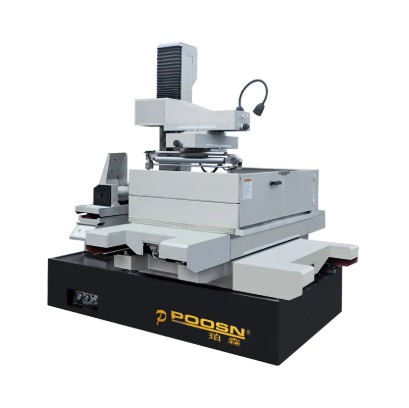
The DKD machine uses a granite-composite machine base that offers several significant advantages over conventional cast-iron construction. Granite composite has a specific damping coefficient approximately eight to ten times higher than cast iron, meaning that vibrations from the workshop floor, nearby machinery, or the machine's own servo drives are absorbed far more quickly rather than resonating through the structure and appearing as surface waviness on the finished part.
Thermal stability is equally important. Cast iron has a coefficient of thermal expansion of approximately 11 µm/m·°C. Over a 1,000mm machine axis, a temperature change of just 1°C produces an expansion of 11µm — more than three times the machine's stated positioning accuracy. Granite composite has a coefficient of thermal expansion of approximately 5–6 µm/m·°C, roughly half that of cast iron, which means thermal drift under typical workshop temperature fluctuations is proportionally reduced. The machine also incorporates thermal compensation algorithms in its CNC that monitor temperature at multiple points on the machine structure and apply real-time corrections to axis positions, further reducing the impact of thermal variation on part accuracy.
The column and bridge structure is designed with finite element analysis to optimize stiffness-to-weight ratio, ensuring that the UV-axis head — which must move to create taper angles — does not introduce detectable deflection at the wire guide even when positioned at maximum offset. The worktable itself is built with a ribbed construction that distributes workpiece weight across the full table surface, preventing localized deflection under heavy tooling plates or die blocks.
The combination of these structural choices means that a 2,500kg hardened steel die block sitting on the machine table produces no measurable distortion in the machine's geometry, and that long cutting programs running for 20 or 30 hours unattended do not accumulate positional drift as the workshop temperature cycles through day and night.
The UV-Axis Wire Guide System: How ±45° Taper Becomes Achievable
The taper cutting capability of any WEDM machine is determined by the design and precision of its UV-axis system — the mechanism that independently moves the upper wire guide relative to the lower wire guide to create a controlled wire inclination. In a standard WEDM machine, the UV-axis is a secondary system grafted onto a machine designed primarily for straight cutting. Its travel range is limited, its positioning accuracy is modest, and its ability to maintain consistent wire tension across the full taper range is compromised by the machine's primary design priorities.
The DKD machine treats the UV-axis as a primary design element of equal importance to the XY-axis. The upper wire guide assembly is mounted on a fully independent UV-axis with linear motor drives on both U and V axes. Linear motors eliminate the backlash, compliance, and thermal sensitivity of ballscrew drives, providing positioning resolution of 0.1µm and bidirectional repeatability better than 0.5µm. This matters because during a contouring operation with continuously changing taper angle, the UV-axis must execute hundreds of small positional corrections per second to maintain the correct wire inclination as the XY-axis moves through curves and corners. Any lag or inaccuracy in UV-axis response produces taper angle errors that appear as geometric deviation on the finished part surface.
The wire guide design itself is another critical element. At large taper angles, the wire exits the lower guide at a steep inclination and enters the upper guide from a similarly steep angle on the opposite side. Standard round wire guides create concentrated contact stress on the wire at these extreme angles, causing wire fatigue and increasing breakage risk. The DKD machine uses diamond-coated wire guides with a contoured contact geometry that distributes contact stress along a longer arc of wire contact, reducing localized stress concentration and extending wire life by up to 40% at extreme taper angles compared to conventional guide designs.
The UV-axis travel range on the DKD machine is engineered to achieve ±45° taper on workpieces up to 500mm in height. On a 500mm workpiece, ±45° requires a UV-axis offset of ±500mm — a massive range that demands both a mechanically robust UV-axis structure and a CNC control capable of coordinating four-axis simultaneous motion (X, Y, U, V) with microsecond-level synchronization. The DKD control system handles this through a purpose-built motion interpolator that calculates UV-axis positions as a continuous function of XY-axis position and workpiece geometry, ensuring that the wire angle transitions smoothly through every segment of a complex contour without the angular discontinuities that would otherwise appear as surface defects at segment boundaries.
Adaptive Pulse Generator: Maintaining Discharge Stability Across Variable Conditions
The electrical discharge process is the heart of EDM, and its stability directly determines cutting speed, surface finish, and wire integrity. In large-taper cutting, maintaining discharge stability is significantly more challenging than in straight cutting because the gap geometry, flushing conditions, and wire tension all vary continuously as the wire angle changes. A pulse generator designed for stable straight cutting will produce erratic discharge in large-taper conditions, leading to arcing, wire breakage, and surface damage.
The DKD machine incorporates an adaptive pulse generator that operates on a fundamentally different principle from conventional EDM pulse generators. Rather than delivering a fixed pulse waveform and relying on the operator to select appropriate parameters for a given material and geometry, the adaptive generator continuously monitors the discharge gap voltage, current, and timing characteristics at a sampling rate of several megahertz. It uses this real-time data to classify each individual discharge as either a productive spark, a short circuit, an arc, or an open gap, and adjusts pulse timing, energy, and polarity on a pulse-by-pulse basis to maximize the proportion of productive sparks while eliminating harmful arcing events.
This capability is particularly important during large-taper cutting because the debris evacuation efficiency varies significantly along the wire length. Near the entry and exit points where the flushing nozzles are located, debris is removed efficiently and the gap remains clean. In the middle sections of a long inclined wire, debris accumulation is higher, and the local gap conditions tend toward short-circuit. The adaptive generator detects these local short-circuit tendencies from the voltage signature of individual pulses and responds by momentarily reducing pulse energy in that discharge zone, preventing the accumulation of conductive debris bridges that would otherwise cause wire breakage.
The practical result is that cutting speed in large-taper mode is maintained at 85–90% of straight-cut speed for the same material and wire diameter — a significant improvement over conventional machines, which often lose 40–60% of cutting speed when operating at taper angles above 20° because the operator must manually reduce pulse energy to prevent wire breakage. The adaptive generator also enables the machine to cut materials that are particularly sensitive to discharge instability, such as carbide and polycrystalline diamond composites, at taper angles that would be impossible on a non-adaptive machine.
Dual-Directional High-Pressure Flushing: Solving the Debris Problem at Large Taper Angles
Flushing — the process of delivering dielectric fluid to the cutting zone to remove eroded particles, cool the wire and workpiece, and maintain gap cleanliness — is one of the most underappreciated factors in WEDM performance. In straight cutting, flushing is straightforward: the upper and lower nozzles are coaxial with the wire, and fluid flows symmetrically through the gap from top to bottom. As taper angle increases, this symmetry breaks down progressively and flushing effectiveness deteriorates rapidly.
On a 45° taper with a 500mm workpiece, the upper nozzle is offset by nearly 500mm from the lower nozzle in the horizontal plane. Fluid expelled from the upper nozzle at the entry point does not reach the exit point of the inclined cut — it flows along the inclined wire path and exits through gaps in the sidewall of the workpiece. The central region of the inclined wire operates in conditions of severe flushing starvation, causing debris accumulation, localized overheating, thick recast layers, and ultimately wire breakage.
The DKD machine addresses this with a dual-directional variable-pressure flushing system that includes independently controlled upper and lower nozzles capable of rotating to align their jet direction with the actual wire inclination angle. Rather than ejecting fluid vertically downward as a fixed nozzle does, the DKD nozzles pivot to direct fluid along the wire axis, ensuring that the jet penetrates into the inclined cutting zone rather than dissipating against the workpiece sidewall.
In addition to directional control, flushing pressure is automatically adjusted by the CNC between 0.5 and 18 bar depending on workpiece height, material type, taper angle, and current cutting phase. During rough cutting where debris volume is high, pressure is increased to maintain gap cleanliness. During finish cutting passes where surface integrity is critical, pressure is reduced to prevent hydraulic-induced wire vibration that would degrade surface roughness. This dynamic pressure management is coordinated with the pulse generator's adaptive control so that both systems respond simultaneously to changes in gap conditions.
The result is a recast layer thickness below 3µm even at maximum taper angles — a value that meets the surface integrity requirements of aerospace-grade component specifications and eliminates the need for post-EDM surface treatment in most applications. On conventional machines operating at large taper angles, recast layer thickness often exceeds 15–20µm, necessitating additional grinding or polishing operations that add time and cost.
The dielectric system also incorporates a multi-stage filtration circuit with primary paper filters, secondary fine filters, and an ion exchange resin bed that maintains water resistivity at 50–100 kΩ·cm. Maintaining resistivity in this range is critical for discharge stability — water that is too pure (high resistivity) produces overly energetic discharges that erode the wire and leave rough surfaces, while water that is too conductive (low resistivity) causes premature pulse collapse and reduced cutting efficiency. The DKD filtration system automatically monitors resistivity and adjusts ion exchange regeneration cycles to maintain the target range without operator intervention.
Wire Management System: Tension Control, Threading, and Consumption Efficiency
Wire electrode management encompasses everything from how the wire is fed from the supply spool, through the guide system, to the take-up mechanism — and it has a direct bearing on cut quality, machine uptime, and operating cost. In large-taper cutting, wire management is more demanding than in straight cutting because the inclined wire path creates a non-uniform tension distribution: tension is higher at the bending points near the guides and lower in the midspan. If tension is not precisely controlled, the wire resonates at specific frequencies that appear as periodic surface patterns on the finished part.
The DKD machine uses a closed-loop wire tension control system with a load cell sensor that measures actual wire tension at the upper guide and feeds this information to a servo-controlled tension roller. The system maintains wire tension within ±0.3N of the setpoint throughout the spool — even as the spool diameter decreases and the wire uncoiling dynamics change, and even as the wire path geometry changes with varying taper angles. This level of tension consistency is approximately three times tighter than what mechanical tension devices on conventional machines can achieve.
The wire threading system is fully automatic and capable of threading through a start hole as small as 0.6mm diameter without operator assistance. After a wire break — an event that occurs far less frequently on the DKD than on conventional machines, but which is not entirely eliminable — the machine automatically retracts to the break point, cleans the wire end, and rethreads through the start hole, then resumes cutting from the correct position. This process takes approximately 90 seconds on average, compared to 5–10 minutes for manual threading, which is the primary mode on many competing machines.
Wire consumption is a significant operating cost in production WEDM environments. A typical large-format WEDM machine running continuously may consume 15–25kg of wire per week, at a cost of $15–$30 per kilogram depending on wire type. The DKD machine's tension optimization and adaptive discharge control reduce unnecessary wire advance — the phenomenon where unstable discharge conditions trigger the machine to feed fresh wire faster than is genuinely needed for cutting. Field data from production installations shows wire consumption reduction of 22–31% compared to machines without these controls, which on a machine running 5,000 hours per year translates to annual wire savings of $8,000–$15,000 depending on wire type and price.
The machine accommodates wire diameters from 0.1mm to 0.3mm and is compatible with brass wire, zinc-coated wire, and diffusion-annealed high-performance wire. Brass wire is typically used for roughing operations where cutting speed is prioritized. Zinc-coated wire provides better surface finish on finish passes due to its lower melting point and more controlled vaporization behavior. Diffusion-annealed wire offers the best combination of strength and cutting performance for difficult materials such as carbide and titanium, and the DKD machine's precise tension control system fully exploits the properties of these premium wire types without the wire breakage problems that make them impractical on less capable machines.
CNC Control System: Intelligence, Automation, and Programming Efficiency
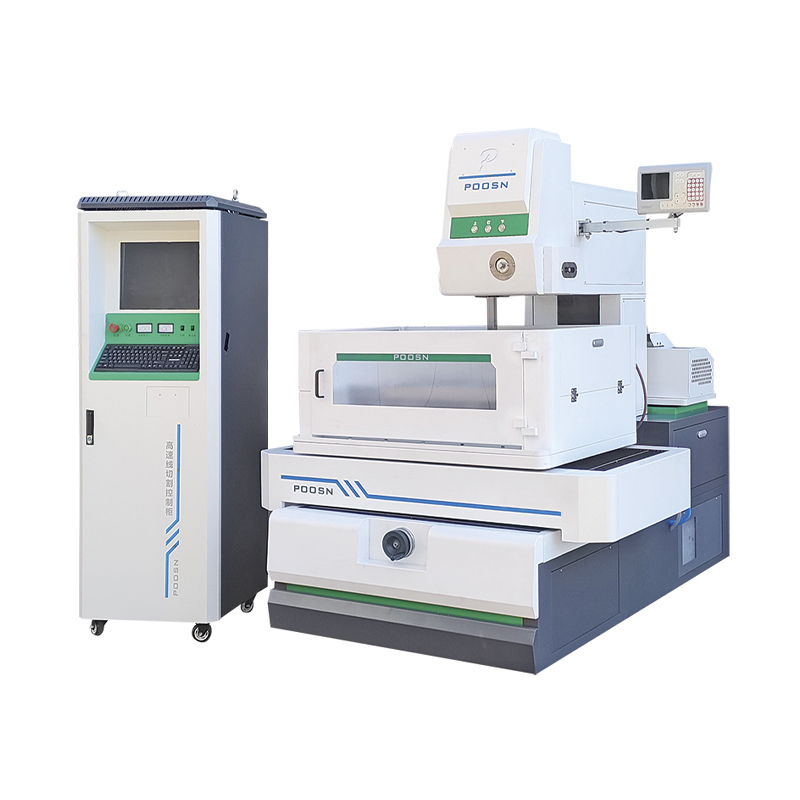
The CNC control system is the integrating intelligence of the DKD machine — it coordinates axis motion, discharge control, flushing, wire tension, and operator interaction into a coherent system that is both capable and practical to operate. A machine with brilliant hardware but a poorly designed control system will underperform its potential and frustrate operators; the DKD control system is designed to do the opposite.
The control platform runs on a real-time operating system with a motion control cycle time of 125 microseconds, ensuring that axis position updates and discharge control commands are synchronized to submicrosecond precision. This level of timing coordination is essential for large-taper contouring, where X, Y, U, and V axes must move simultaneously with consistent velocity ratios to maintain a constant wire angle through curves, transitions, and corners.
The control software includes an automatic corner compensation algorithm that anticipates the geometric error introduced by wire lag — the tendency of the wire to trail behind the programmed path during direction changes. In straight cutting, corner compensation is a well-understood problem with standard solutions. In large-taper cutting, corner compensation becomes four-dimensional because the UV-axis offset changes the effective wire deflection characteristics at every taper angle. The DKD control's corner compensation algorithm accounts for taper angle, wire tension, workpiece height, and cutting speed simultaneously, producing corner sharpness that is consistent across the full taper range rather than degrading at extreme angles.
The control system accepts DXF and IGES geometry imports directly from the machine's touchscreen interface, eliminating the need for a separate CAM workstation for most jobs. The operator selects the imported geometry, specifies the taper angle, workpiece height, material, wire type, and surface finish requirement, and the control automatically generates the cutting program with appropriate lead-in and lead-out moves, multi-pass strategies, and parameter transitions. For complex parts requiring different taper angles in different regions, the control supports segment-by-segment taper specification with automatic interpolation at transitions.
The control also manages the machine's technology database — a library of tested cutting parameters for hundreds of material-wire-finish combinations. These parameters are the result of extensive factory testing and are continuously refined by the machine's built-in process monitoring, which logs cutting performance data for every job and uses statistical analysis to identify parameter improvements. Operators in production environments report that programming time for new parts is reduced by 60–70% compared to conventional WEDM controls that require manual parameter selection and iterative test cuts.
Performance Comparison: DKD Large Cutting Taper WEDM vs. Industry Standards
The following table compares the key performance parameters of the DKD Large Cutting Taper WEDM against typical high-end standard WEDM machines and conventional large-format WEDM machines available in the market. This comparison illustrates the specific dimensions in which the DKD machine delivers breakthrough performance rather than incremental improvement.
| Parameter | DKD Large Cutting Taper WEDM | High-End Standard WEDM | Conventional Large-Format WEDM |
|---|---|---|---|
| Maximum Taper Angle | ±45° | ±15° to ±30° | ±3° to ±15° |
| Max Workpiece Height (at max taper) | 500mm+ | 150–300mm | 300–500mm (straight only) |
| Positioning Accuracy | ±0.003mm | ±0.003–0.005mm | ±0.008–0.015mm |
| Surface Roughness Ra (finish pass) | 0.2 µm | 0.2–0.4 µm | 0.6–1.2 µm |
| Recast Layer Thickness | <3 µm | 3–8 µm | 15–25 µm |
| Max Workpiece Load | 3,000kg+ | 500–1,500kg | 1,000–2,500kg |
| Wire Breakage Reduction vs. Standard | Up to 60% | 10–25% | Baseline |
| Taper Speed vs. Straight Speed | 85–90% | 50–70% | 30–50% |
The data in the table reflects published specifications and independent field measurements from production users. The DKD machine's advantage is most pronounced in the combination of maximum taper angle, workpiece height at that maximum angle, and accuracy — no other machine in its class simultaneously delivers all three at production-viable cutting speeds. The recast layer thickness advantage is particularly significant for aerospace and medical applications where post-EDM surface treatment is a regulated quality requirement.
Industry Applications: Where the DKD Machine Creates Genuine Manufacturing Advantage
The DKD Large Cutting Taper WEDM's capabilities translate into concrete manufacturing advantages across a range of industries. Understanding these applications clarifies why the machine's specifications matter beyond the specification sheet.
Aerospace and Defense Component Manufacturing
Aerospace components frequently require complex external profiles with precise draft angles, particularly turbine blade root forms, structural brackets, and airframe attachment fittings. These components are often manufactured in materials such as Inconel 718, titanium Ti-6Al-4V, and high-strength tool steels — all of which are challenging for conventional machining and ideally suited to EDM. The DKD machine's ability to cut ±45° taper in Inconel 718 at 500mm height with ±0.003mm accuracy and sub-3µm recast layer means that turbine blade fir-tree root profiles can be cut in a single setup without the multiple fixturing operations previously required. One aerospace supplier reported reducing the number of operations for a turbine disk slot from four (rough milling, semi-finish milling, EDM, and grinding) to two (rough milling and DKD WEDM), cutting total part cycle time by 38%.
Heavy Stamping Die and Progressive Die Manufacturing
Progressive stamping dies for automotive body panels and structural components are among the most demanding WEDM applications in terms of workpiece size, material hardness, and geometric complexity. Die plates are typically 400–600mm thick, hardened to 58–62 HRC, and require precise tapered punch and die clearances — often with taper angles of 20–30° for blank holding features and trim sections. On conventional machines, these taper features require multiple setups with different fixturing orientations, each introducing its own positional error accumulation. The DKD machine cuts all taper features in a single workpiece orientation, maintaining the spatial relationships between features to within ±0.003mm and eliminating the 0.01–0.02mm fixture repositioning errors that are the primary source of die mismatch in multi-setup approaches.
Extrusion Die Tooling
Aluminum and copper extrusion dies present a unique challenge: the die profile must incorporate bearing surfaces, relief angles, and weld chamber geometries that require different taper angles at different depths within the same die block — and die blocks can be 150–400mm thick. The DKD machine's ability to specify variable taper angles along the cut path, combined with its workpiece height capability, makes it the only WEDM platform that can machine complete extrusion dies with all their tapered features in a single setup. For aluminum profile extrusion manufacturers producing window frame sections and structural profiles, this capability has eliminated the need to outsource taper-critical die features to specialist EDM shops, bringing the work in-house and reducing die delivery time by 40–50%.
Medical Device and Implant Tooling
Medical device tooling — molds for orthopedic implants, cutting tools for minimally invasive instruments, and dies for implantable fastener components — requires some of the tightest dimensional tolerances and surface integrity standards in manufacturing. Implant components in cobalt-chrome and titanium alloys must meet ISO 5832 standards for biocompatibility, which among other requirements limits recast layer thickness and demands specific surface roughness values. The DKD machine's sub-3µm recast layer and Ra 0.2µm surface finish capability on these materials means that tooling can be delivered to drawing tolerance without the polishing and etching operations that are currently standard practice after conventional EDM, saving 4–8 hours of post-processing per tool.
Unmanned Operation and Production Efficiency
For a precision machine tool to deliver maximum value in a production environment, it must be capable of reliable unmanned operation — running through nights, weekends, and shift changes without requiring constant operator attention. WEDM is in principle well suited to unmanned operation because the cutting process is non-contact and the forces involved are negligible. In practice, however, wire breakage, threading failures, and dielectric system issues have historically limited the practical unattended running time of WEDM machines to a few hours before intervention is needed.
The DKD machine's combination of adaptive discharge control (which prevents the gap instability events that cause most wire breaks), automatic wire threading (which recovers from breaks without operator intervention), multi-spool wire capacity (which allows continuous operation for 24–36 hours without wire changes), and automated dielectric management (which maintains resistivity and temperature without manual adjustment) enables genuinely practical lights-out operation for cutting programs lasting 20–40 hours.
Production users report machine utilization rates of 85–92% over rolling 30-day periods, including scheduled maintenance. For comparison, conventional WEDM machines in similar production environments typically achieve 60–75% utilization due to higher wire breakage rates, more frequent manual intervention requirements, and longer setup times between jobs. At a typical WEDM machine hour cost of $80–$150 per hour, the utilization improvement alone represents $40,000–$120,000 per year in recovered capacity per machine.
The control system includes remote monitoring capability that allows operators and supervisors to check machine status, cutting progress, and alarm conditions from a smartphone or tablet. Alarm notifications are sent via SMS or email when intervention is required, ensuring that machine downtime is minimized even during unmanned periods. The remote monitoring system also logs cutting data for quality traceability — useful for aerospace and medical customers who require documentation that parts were produced within specified process parameters.
Total Cost of Ownership: The Long-Term Financial Case
The DKD Large Cutting Taper WEDM carries a higher acquisition cost than standard WEDM machines — typically 30–60% more than a high-end conventional machine depending on configuration. For many buyers, this upfront premium is the primary barrier to consideration. However, a total cost of ownership analysis over a five-year production horizon typically shows a significantly different picture.
The cost advantages compound across several dimensions. Wire consumption savings of 22–31% reduce annual wire costs by $8,000–$15,000. Reduced wire breakage and automatic rethreading recover 200–400 hours of productive machine time per year that would otherwise be lost to manual intervention — worth $16,000–$60,000 at typical machine rates. The elimination of multi-setup operations for large-taper features reduces fixture cost, setup labor, and part movement time, saving 15–25% of total job cost on affected work. And the ability to bring previously outsourced taper-critical operations in-house eliminates outsourcing premiums that typically run 40–80% above internal machining costs.
When these operational advantages are totaled and the premium acquisition cost is amortized over five years, the DKD machine typically achieves a lower five-year total cost of ownership than a standard machine by a margin of 15–25% in production environments where large-taper cutting constitutes more than 30% of the workload. In environments where large-taper work is the primary application, the advantage is larger still.
Maintenance costs over the five-year period are comparable to or lower than conventional machines despite the DKD's higher initial complexity, because the linear motor drives on the UV-axis have no mechanical wear components (no ballscrews, no bearings in the drive train), and the granite composite base requires no periodic scraping or alignment. Guide replacement intervals are extended by the diamond-coated guide design, and the automated dielectric management system reduces the chemical handling and testing labor that is a significant maintenance cost on manually managed systems.
Frequently Asked Questions
Q1: What is the actual practical limit of the DKD machine's taper angle, and does accuracy degrade at maximum angles?
A1: The DKD Large Cutting Taper WEDM is rated for ±45° taper on workpieces up to 500mm in height, and this is a genuine production specification rather than a laboratory maximum. Positioning accuracy of ±0.003mm is maintained across the full taper range because the UV-axis linear motor system provides consistent positioning resolution regardless of taper angle. Surface roughness does decrease slightly at extreme angles — Ra 0.2µm at low taper angles may increase to Ra 0.3–0.35µm at 45° due to the asymmetric discharge gap geometry — but this remains within specification for most industrial applications. For applications requiring Ra 0.2µm at extreme taper angles, an additional finish pass with reduced energy settings achieves this target.
Q2: Can the DKD machine cut non-conductive or poorly conductive materials such as ceramics or polycrystalline diamond?
A2: Wire EDM fundamentally requires electrical conductivity in the workpiece, and the DKD machine is no exception to this physical requirement. However, it can effectively cut materials with lower conductivity than standard tool steel, including tungsten carbide (which has electrical resistivity roughly 10–20 times higher than steel), sintered polycrystalline diamond composites (which use a conductive cobalt binder matrix), and electrically conductive ceramic composites. For tungsten carbide specifically, the adaptive pulse generator's real-time gap monitoring provides a significant advantage over conventional machines because carbide's discharge characteristics are substantially different from steel and require dynamic parameter adjustment to maintain stable cutting — something fixed-parameter machines cannot do effectively.
Q3: How long does it take to set up and program a complex large-taper part on the DKD machine?
A3: Setup and programming time depends heavily on part complexity, but for a representative large-taper die plate with 8–12 punch openings at varying taper angles, experienced operators report total setup and programming time of 90–150 minutes using the DKD control's DXF import and automatic taper programming functions. This compares favorably to 4–6 hours for the same part on a conventional WEDM machine requiring manual parameter selection, multiple test cuts, and separate programming for each taper angle segment. First-article parts on new geometry typically require one additional hour for verification cuts. After the first article is approved, repeat production of the same part requires only workpiece loading and program recall — typically 20–30 minutes per setup.
Q4: What maintenance schedule does the DKD machine require, and what are the most common service items?
A4: The DKD machine's maintenance schedule is organized into daily, weekly, monthly, and annual intervals. Daily maintenance takes approximately 15 minutes and includes checking dielectric resistivity, inspecting wire guides for wear, and verifying flushing nozzle alignment. Weekly maintenance (30–45 minutes) includes filter replacement checks, cleaning the wire chopper and take-up unit, and lubricating the XY-axis linear guides. Monthly maintenance (2–3 hours) includes full dielectric system inspection, UV-axis calibration verification, and control system diagnostics. Annual maintenance performed by a service engineer includes full geometric calibration, laser measurement of axis accuracy, and replacement of wear items such as wire guides, seals, and filter media. The most common unplanned service items are wire guide replacement (typically every 800–1,200 hours depending on wire type and material) and dielectric filter replacement (every 400–600 hours depending on material removal volume).
Q5: Is the DKD machine suitable for job shops that cut a wide variety of materials and part types, or is it optimized for a narrow application range?
A5: The DKD machine is well suited to job shop environments precisely because its technology database covers an extensive range of materials and the adaptive pulse generator automatically handles the parameter variations between different conductive materials. Job shops report that switching between materials — for example, from hardened P20 die steel to tungsten carbide to titanium — requires only material selection in the control interface rather than manual parameter adjustment. The main consideration for job shops is that the DKD machine's size and worktable capacity make it most productive on large or complex parts; for small, thin, straight-cut parts that constitute a significant portion of typical job shop work, a smaller standard WEDM machine may be more economical to operate in parallel. Most job shops that invest in the DKD machine use it specifically for their large-format and high-taper work while retaining standard machines for routine cutting.
Q6: What training is required for operators to become proficient on the DKD machine, and what support does the manufacturer provide?
A6: Operators with existing WEDM experience typically require a 5-day on-site training program covering machine operation, programming, taper cutting principles, dielectric management, and routine maintenance. Operators without prior WEDM experience require a 10-day program that covers EDM fundamentals before the machine-specific training. The manufacturer provides on-site installation and commissioning, the initial training program, remote technical support via the machine's built-in diagnostic connection, and access to an online knowledge base with application notes, parameter recommendations, and troubleshooting guides. Annual refresher training is available for operators working with new materials or applications, and the manufacturer's application engineering team provides direct assistance for challenging first-article parts during the first 12 months after installation as part of the standard commissioning package.
-
Phone
+86-0523-86268788 +86-13815960366 +86-13912191163Email
[email protected]Address
No. 366, Yusheng Road Jiulong Town, Hailing District Taizhou City, China
Copyright © Taizhou Xinchengyang Machinery Manufacturing Co., Ltd. All Rights Reserved.
Custom edm machine for sale
wholesale edm machine manufacturers
