

 English
 русский
 عربى


Industry News
Home / News / Industry News / Wire EDM for Carbide: Precision Cutting Guide from a China Wire EDM Manufacturer
Wire EDM for Carbide: Precision Cutting Guide from a China Wire EDM Manufacturer
2026-09-28
When a mold shop tries to cut a carbide punch with a standard wire EDM program, the first sign of trouble is usually a broken wire or an oversized corner. Carbide, or tungsten carbide, is not just hard; it is electrically conductive but thermally sensitive, and its binder phase behaves differently from steel. Wire EDM for carbide is absolutely feasible, but the window between a clean cut and a scrapped workpiece is narrower than most operators expect. The practical answer is to treat carbide as its own process category: choose a machine with stable discharge control, select the right wire, and plan multiple skim passes. This guide explains what changes when the workpiece is carbide, how to match machine specifications to the job, and where a China wire EDM manufacturer fits into the sourcing picture.
Key takeaway: Carbide can be cut reliably by wire EDM, but success depends on controlled discharge energy, proper wire selection, and a machine capable of consistent multi-cut operation.
Content
- 1 Why Carbide Behaves Differently in Wire EDM
- 2 How Wire EDM Cuts Carbide: Principle and Practical Limits
- 3 Machine Specifications That Matter for Carbide
- 4 Wire Electrode Selection for Carbide
- 5 Chart: Carbide Removal Rate and Surface Finish by Machine Type
- 6 Common Carbide Applications and Selection Guide
- 7 Maintenance and Operation Tips for Carbide Wire EDM
- 8 FAQ: Wire EDM for Carbide
- 8.1 Can wire EDM cut tungsten carbide?
- 8.2 Which wire EDM machine is best for carbide?
- 8.3 How many trim passes are needed for carbide?
- 8.4 What wire is best for cutting carbide?
- 8.5 How do I avoid microcracks in the carbide surface?
- 8.6 Can a China wire EDM manufacturer supply machines for carbide work?
- 9 Where to Source Wire EDM Machines for Carbide
Why Carbide Behaves Differently in Wire EDM
Tungsten carbide is a composite material: hard tungsten carbide grains held together by a metallic binder, usually cobalt or nickel. That structure gives it exceptional wear resistance, but it also creates specific challenges for electrical discharge machining. The carbide grains have very high melting points, while the binder melts at a much lower temperature. During a spark, the binder can be preferentially eroded, leaving unsupported grains that may break away instead of being cleanly melted. This is why carbide often produces a rougher surface and a wider recast layer than tool steel under the same discharge energy.
Another factor is electrical resistivity. Carbide is conductive, but its resistivity is higher than that of steel. That means the discharge channel forms differently, and the machine must deliver a slightly higher open-circuit voltage to initiate the spark consistently. If the generator cannot adapt, you get unstable discharges, wire breakage, and poor corner accuracy. Thermal conductivity is also lower than steel, so heat concentrates near the cut. Without adequate cooling and controlled pulse intervals, microcracks can appear in the carbide surface. These effects are not theoretical; they show up in the first few millimeters of a test cut, and they dictate the entire process plan.
| Property | Tungsten Carbide | Tool Steel (D2) | Process Implication |
|---|---|---|---|
| Hardness (HV) | 1200–1800 | 600–800 | Carbide requires lower discharge energy to avoid microcracks. |
| Electrical resistivity | Higher | Lower | Higher open-circuit voltage needed for stable ignition. |
| Thermal conductivity | Lower | Higher | Heat stays near the cut; more skim passes and cooling needed. |
| Binder phase | Cobalt or nickel | None | Binder can be selectively eroded, affecting surface integrity. |
| Typical removal rate | 20–50% of steel | Baseline | Plan longer cycle times or rough with high-speed WEDM. |
| Surface finish after one cut | Ra 3.2–6.3 µm | Ra 2.0–4.0 µm | Multi-cut strategy is mandatory for tight tolerances. |
| Wire wear | Higher | Moderate | Use coated wire or increase wire speed to reduce breakage. |
Key takeaway: Carbide’s composite structure and higher resistivity mean standard steel parameters will underperform; the process must be adapted from the first spark.
How Wire EDM Cuts Carbide: Principle and Practical Limits
Wire EDM removes material through controlled electrical discharges between a moving wire electrode and the workpiece, both submerged in deionized water. Each discharge melts and vaporizes a tiny volume of material. For carbide, the discharge energy must be kept low enough to avoid thermal shock, but high enough to erode the hard grains. The result is a relatively slow but precise cut that does not depend on the material’s hardness. That is the main advantage: a 90 HRA carbide punch can be cut with the same setup that handles hardened steel, provided the parameters are adjusted.
The practical limit is the recast layer. In carbide, the recast layer can contain microcracks, increased cobalt content, and even free carbon. If the part is used in a high-cycle stamping die, those microcracks can propagate under load. The solution is a multi-cut sequence: one or more rough cuts to remove the bulk, followed by two to four trim cuts that progressively reduce the damaged layer. Each trim cut removes only a few microns, but it stabilizes the surface and improves dimensional accuracy. On a medium-speed wire EDM machine, the wire travels unidirectionally, so the discharge conditions remain consistent from top to bottom. That consistency is why medium-speed WEDM is often preferred for carbide tooling.
Another limit is flushing. Carbide debris is abrasive and can accumulate in the cut if the flushing pressure is too low. But excessive flushing can vibrate the wire and cause wire breakage. Operators typically start with lower flushing pressure and increase it only if the cut shows signs of short-circuiting. The dielectric water also needs regular attention: conductivity should be kept between 5 and 15 µS/cm, and the filters must be clean to prevent cobalt ions from building up in the tank.
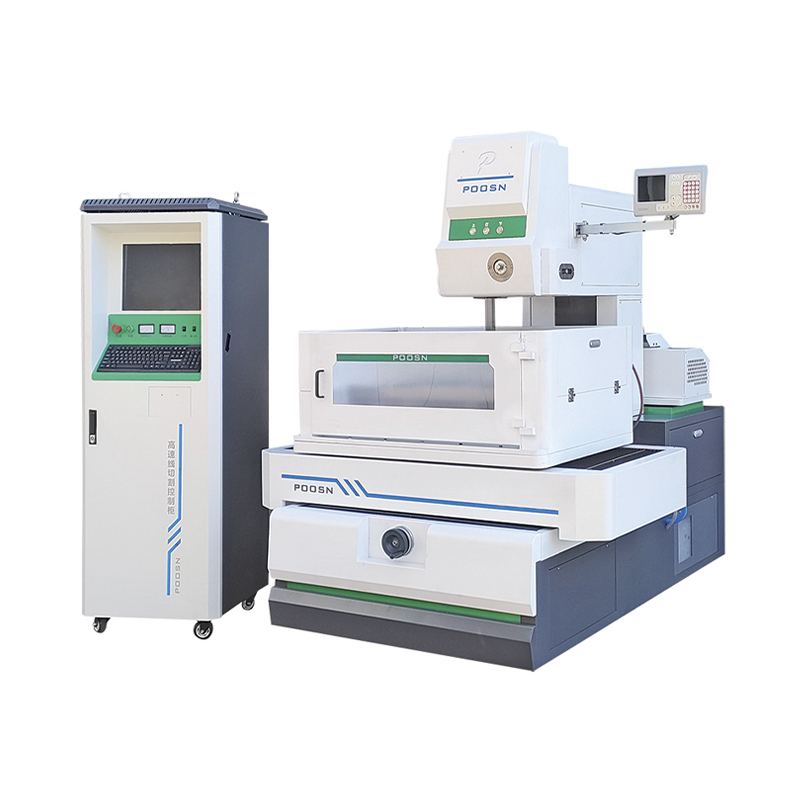
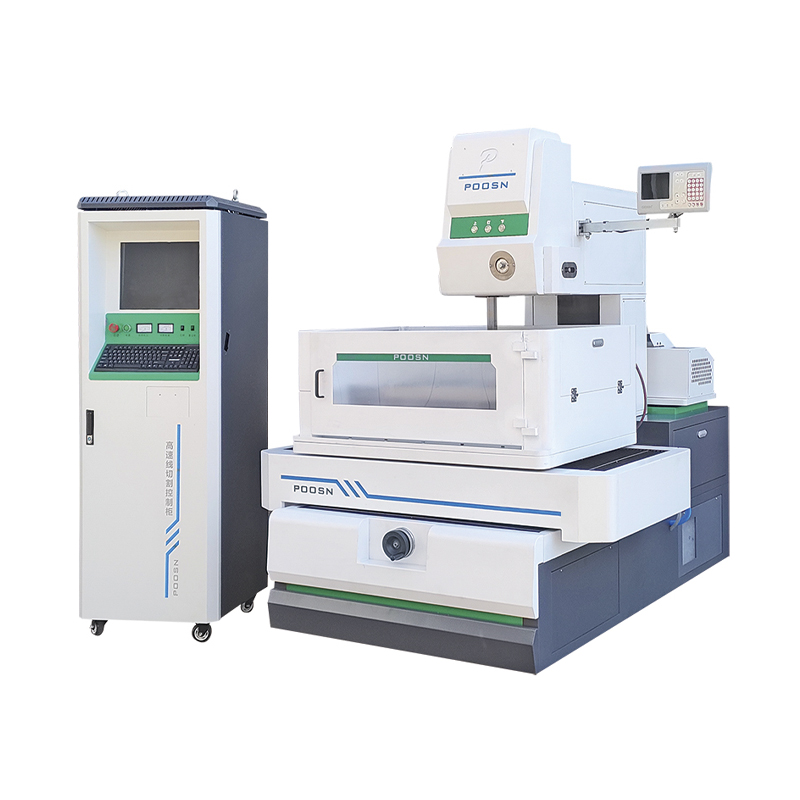 PS35C Precision CNC Medium Speed Wire Cut EDM MachinePS35C series Medium Speed Wire-cut EDM machine is a piece of equipment specially designed for precision cutting of medium-sized workpieces, featuring high working effi...View Product →
Key takeaway: Carbide cutting is a multi-cut process; the rough cut removes material, but the trim cuts determine whether the carbide survives in service.
Machine Specifications That Matter for Carbide
Not every wire EDM is equally suited to carbide. The key specifications are discharge control resolution, wire tension stability, and the number of trim passes. High-speed wire EDM (HS-WEDM) uses a reciprocating wire and is cost-effective for roughing, but its surface finish and corner accuracy are limited. Medium-speed wire EDM (MS-WEDM) uses a unidirectional wire path, which reduces wire wear and delivers better surface integrity. For carbide, the difference is significant: a medium-speed machine can hold ±0.005 mm on a carbide die insert, while a high-speed machine may struggle to hold ±0.02 mm.
| Machine Type | Wire Path | Typical Accuracy | Surface Finish | Best Use for Carbide |
|---|---|---|---|---|
| High-speed WEDM (HS-WEDM) | Reciprocating molybdenum wire | ±0.015–0.02 mm | Ra 2.5–3.2 µm | Roughing, simple shapes, cost-sensitive parts |
| Medium-speed WEDM (MS-WEDM) | Unidirectional wire | ±0.005–0.01 mm | Ra 0.8–1.6 µm | Precision dies, punches, multi-cut finishing |
| Large-taper WEDM | Unidirectional or reciprocating | ±0.01–0.015 mm | Ra 1.6–2.5 µm | Complex molds with draft angles, carbide inserts |
When you are comparing a CNC wire EDM machine for carbide work, look beyond the headline accuracy. Ask about the minimum discharge energy, the resolution of the servo control, and whether the machine can automatically adjust parameters for each trim pass. A machine with a rigid frame and thermal compensation will hold accuracy over long cuts. For heavy carbide sections, a larger wire diameter (0.25 mm instead of 0.20 mm) can improve flushing and reduce wire breakage, but it also increases the kerf width. The trade-off must be evaluated against the part geometry.
PS-C Series
Medium-speed WEDM for precision carbide dies and punches.
DK-BC Series
High-medium-speed WEDM balance between cost and accuracy.
DKD Series
Large-taper cutting for complex carbide mold inserts.
DK77 Series
High-speed WEDM for roughing carbide blocks economically.
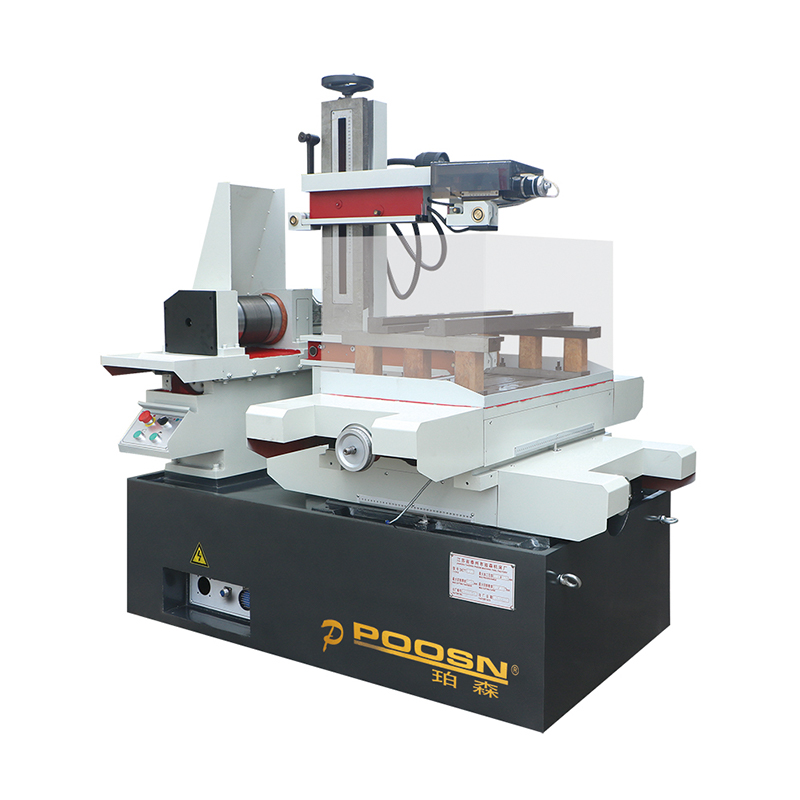 DK-7745 CNC High-Speed Wire EDM Machine (4-Axis, 400×600mm Travel)DK-7745 High-Speed Wire EDM: A device specifically designed for complex shapes and high-precision parts, offering accurate and reliable machining performance. This mac...View Product →
Key takeaway: For carbide, prioritize a medium-speed WEDM with multi-cut capability; high-speed machines are best reserved for roughing or non-critical features.
Wire Electrode Selection for Carbide
The wire electrode is not just a consumable; it is part of the process recipe. For carbide, the wire must resist wear and maintain a stable discharge. Plain brass wire is common for steel but wears quickly in carbide because the cobalt binder accelerates diffusion. Zinc-coated wire offers better flushing and lower wear, making it a popular choice for carbide roughing. For finishing passes, a diffusion-annealed wire or a composite wire with a high-zinc core can deliver a finer surface and reduce the risk of cobalt leaching.
Molybdenum wire is standard on high-speed WEDM machines. It is strong and can handle high tension, but it produces a wider spark gap and leaves a rougher surface. If you are using a high-speed machine for carbide roughing, molybdenum wire is acceptable. However, for final dimensions, switch to a medium-speed machine with brass or coated wire. The table below summarizes common wire options.
| Wire Type | Diameter Range | Coating | Advantages for Carbide | Limitations |
|---|---|---|---|---|
| Plain brass | 0.20–0.30 mm | None | Low cost, good for steel | High wear in carbide, poor flushing |
| Zinc-coated brass | 0.20–0.30 mm | Zinc | Better flushing, reduced wire breakage | Slightly higher cost |
| Diffusion-annealed | 0.20–0.25 mm | Zinc-rich surface | Excellent surface finish, low wear | Best for finishing passes only |
| Molybdenum | 0.18–0.25 mm | None | High tensile strength, reusable | Rougher surface, wider kerf |
| Composite (steel core) | 0.20–0.30 mm | Brass/zinc | High tension, good for tall parts | Higher cost, specific machine requirements |
Key takeaway: Match the wire to the pass: use coated or molybdenum wire for roughing, and diffusion-annealed wire for finishing carbide to minimize surface damage.
Chart: Carbide Removal Rate and Surface Finish by Machine Type
The relationship between removal rate and surface finish is the central trade-off in carbide wire EDM. A faster cut usually means higher discharge energy, which leaves a thicker recast layer. A slower cut with multiple trim passes improves surface integrity but increases cycle time. Understanding this balance helps you choose the right machine and process strategy. The chart below compares three common machine categories on two dimensions: relative removal rate and achievable surface finish. The values are normalized for a 40 mm thick tungsten carbide workpiece with 12% cobalt binder.
Relative Removal Rate and Surface Finish by Machine Type
High-speed WEDM (roughing)
Removal: 95%
Finish: 40%
Medium-speed WEDM (multi-cut)
Removal: 65%
Finish: 90%
Large-taper WEDM (complex shapes)
Removal: 75%
Finish: 70%
Higher percentage indicates better performance relative to the best result in each category. Removal rate and surface finish are inversely correlated in single-pass operations.
The chart makes the trade-off visible. High-speed WEDM delivers the highest removal rate, reaching 95% of the normalized maximum, but its surface finish ranks lowest at 40%. That combination is acceptable for roughing a carbide blank where subsequent grinding or finishing will remove the damaged layer. Medium-speed WEDM, by contrast, gives up some speed—65% removal rate—but achieves a 90% finish score, which means it can produce a carbide die insert that requires little or no manual polishing. Large-taper WEDM sits in the middle: 75% removal and 70% finish, reflecting its ability to cut angled features without sacrificing too much surface quality.
For a mold shop cutting a complex carbide insert with a 15-degree draft, the large-taper machine may be the only practical option. The angled cut must be completed in one setup, and the surface finish needs to be good enough to avoid hand benching. In that case, the 70% finish score translates to roughly Ra 1.8 µm, which is acceptable for many injection mold cores. If the insert requires Ra 0.8 µm, the shop would need to run additional trim passes on a medium-speed machine, effectively reducing the removal rate to 50% or lower.
The chart also highlights why machine selection cannot be based on a single number. A high-speed machine with a 95% removal rate might finish a roughing cut in 2 hours, but if it leaves a 20 µm recast layer, the subsequent finishing operation could take 6 hours. A medium-speed machine might take 3 hours for the same roughing cut, but the recast layer is only 8 µm, so finishing takes 2 hours. The total cycle time favors the medium-speed machine, and the carbide surface integrity is better. This is the calculation that experienced toolmakers perform before quoting a carbide job.
Another observation from the chart is the gap between removal rate and finish score. For high-speed WEDM, the gap is 55 percentage points; for medium-speed, it is 25 points; for large-taper, it is 5 points. A smaller gap means the machine is more balanced, but balance is not always the goal. If the part is a simple rectangular carbide wear plate with generous tolerances, the high-speed machine’s large gap is irrelevant. If the part is a precision punch with a 0.005 mm tolerance, the medium-speed machine’s smaller gap is essential.
Finally, consider that the chart values are normalized for a specific workpiece. Changing the carbide grade—for example, from 12% cobalt to 6% cobalt—will shift the finish scores downward because the lower binder content makes the material more brittle and prone to microcracking. Increasing the workpiece thickness from 40 mm to 80 mm will also reduce removal rates across the board, but the medium-speed machine may retain its finish advantage better because it maintains consistent wire tension. These variables mean the chart should be used as a starting point, not a fixed specification.
Key takeaway: The chart confirms that medium-speed WEDM offers the best balance for carbide, but high-speed machines still have a place for roughing when surface integrity is not the limiting factor.
Common Carbide Applications and Selection Guide
Carbide wire EDM is used across industries where wear resistance and precision are both critical. The most common applications include stamping dies, punching tools, drawing dies, wear plates, and injection mold inserts. In each case, the carbide part must be cut to final shape after sintering and grinding, and wire EDM is often the only process that can produce the required geometry without inducing cracks. For example, a progressive stamping die for electrical connectors uses carbide inserts with complex profiles; wire EDM cuts the profile and the relief angles in one setup.
When selecting a wire EDM for carbide, start with the part envelope and tolerance. If the part is larger than 300 mm × 400 mm, you will need a machine with a larger work table and a stable frame. If the tolerance is tighter than ±0.01 mm, prioritize a medium-speed WEDM with closed-loop control and thermal compensation. If the part includes tapers greater than 15 degrees, a large-taper machine is necessary. The table below summarizes the selection logic.
| Application Requirement | Recommended Machine Type | Key Specification | Typical Wire |
|---|---|---|---|
| Roughing large carbide blocks | High-speed WEDM | High removal rate, large work table | Molybdenum 0.20 mm |
| Precision dies and punches | Medium-speed WEDM | Multi-cut, ±0.005 mm accuracy | Zinc-coated brass 0.25 mm |
| Complex molds with draft | Large-taper WEDM | Up to 30° taper, stable tension | Diffusion-annealed 0.25 mm |
| Small, delicate inserts | Medium-speed WEDM | Low discharge energy, fine finish | Diffusion-annealed 0.20 mm |
| High-volume production | Medium-speed WEDM | Automatic wire threading, reliable AWC | Composite wire 0.30 mm |
Beyond the machine, consider the total process cost. Carbide is expensive, and a scrapped part can cost hundreds or thousands of dollars. That makes the reliability of the wire EDM machine critical. A machine with an automatic wire threading system reduces the risk of human error, but it adds complexity. For a shop that cuts carbide daily, the investment is justified. For a shop that cuts carbide occasionally, a simpler machine with manual threading may be sufficient. The decision should be based on the annual volume of carbide work and the value of the parts being cut.
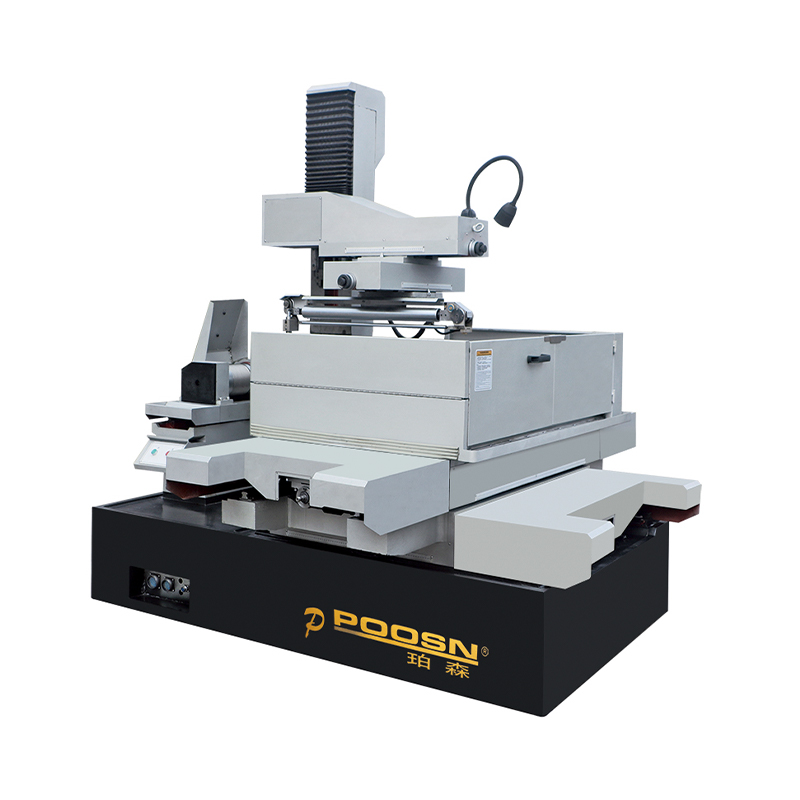 DK45D CNC Large Taper Wire Cut EDM Machine for Precision Mold MachiningDK45D Series Large-Taper Wire EDM: Specifically designed for high-precision, large-taper cutting tasks, this series is ideal for precision machining requiring signific...View Product →
Key takeaway: Match the machine to the part envelope, tolerance, and taper requirements; for carbide, precision and surface integrity usually outweigh pure speed.
Maintenance and Operation Tips for Carbide Wire EDM
Carbide cutting puts extra stress on the wire EDM system, so maintenance intervals should be shorter than for steel work. The dielectric water must be kept clean: cobalt and tungsten ions accumulate quickly, and if the conductivity rises above 15 µS/cm, discharge stability suffers. Check the deionization resin and filters every 100 hours of carbide cutting, or more often if the machine runs continuously. The water temperature should be controlled within ±1°C to prevent thermal distortion of the workpiece.
Wire guides and contact shoes wear faster with carbide because the abrasive debris enters the flushing path. Inspect the guides every 200 hours and replace them if the wire diameter changes by more than 0.01 mm. The wire tension should be kept at the upper end of the machine’s range, but not so high that the wire breaks. For a 0.25 mm coated wire, a tension of 12–15 N is typical on a medium-speed machine. On a high-speed machine with molybdenum wire, tension is usually 8–12 N.
Operationally, the most important rule is to never skip trim passes. A carbide part that looks acceptable after a rough cut will often fail in service because the recast layer contains microcracks. Run at least two trim passes, and for critical dies, run four. The first trim pass removes 20–30 µm, the second removes 10–15 µm, and the final passes remove 5 µm or less. Keep the flushing pressure moderate during trim passes to avoid wire vibration. If the machine allows, use a lower wire speed for the final pass to reduce wire marks.
Finally, document the parameters for each carbide grade and part geometry. Carbide grades from different suppliers can behave differently, and a recipe that works for one batch may not work for another. Keep a log of discharge energy, pulse frequency, wire speed, and flushing pressure. Over time, this log becomes a valuable knowledge base that reduces setup time and scrap rate.
Key takeaway: Carbide demands shorter maintenance cycles and strict multi-cut discipline; skimping on trim passes is the fastest way to scrap an expensive part.
FAQ: Wire EDM for Carbide
Can wire EDM cut tungsten carbide?Yes. Tungsten carbide is electrically conductive, so wire EDM can cut it. However, the process requires lower discharge energy and multiple trim passes because the cobalt binder can be selectively eroded. Without proper parameters, the cut may produce microcracks and a rough surface. |
Which wire EDM machine is best for carbide?A medium-speed wire EDM machine (MS-WEDM) with multi-cut capability is generally best. It maintains consistent wire tension and delivers a fine surface finish. High-speed WEDM can be used for roughing, but it is not suitable for final dimensions on carbide. |
How many trim passes are needed for carbide?At least two trim passes, and up to four for precision dies. Each pass removes progressively less material: 20–30 µm, 10–15 µm, and 5 µm or less. The trim passes remove the recast layer and improve surface integrity. |
What wire is best for cutting carbide?Zinc-coated brass wire is a good all-purpose choice for roughing and intermediate cuts. For finishing, diffusion-annealed wire provides a finer surface. Molybdenum wire is acceptable for high-speed roughing but leaves a rougher finish. |
How do I avoid microcracks in the carbide surface?Use low discharge energy, keep the dielectric clean, and never skip trim passes. Also, maintain stable wire tension and moderate flushing pressure. If microcracks still appear, reduce the pulse duration and increase the pulse interval. |
Can a China wire EDM manufacturer supply machines for carbide work?Yes. Many China wire EDM manufacturers, including Taizhou Xinchengyang, produce medium-speed and large-taper machines that are suitable for carbide. The key is to verify the machine’s multi-cut capability, thermal stability, and after-sales support before purchasing. |
Key takeaway: The FAQ answers confirm that carbide wire EDM is a mature process, but it requires the right machine, wire, and multi-cut strategy to avoid costly failures.
Where to Source Wire EDM Machines for Carbide
If you are evaluating a wire EDM machine for carbide production, the most reliable path is to work directly with a manufacturer that understands the material. Taizhou Xinchengyang Machinery Manufacturing Co., Ltd has been building wire EDM machines since 1999, with the POOSN brand established in 2003. The company offers four product lines that cover high-speed, medium-speed, and large-taper cutting, all of which can be configured for carbide work. The PS-C series medium-speed machines are particularly well suited to precision carbide dies, while the DK77 high-speed series handles roughing economically. The DKD large-taper series addresses complex mold inserts with angled features.
As a China wire EDM manufacturer, the company exports to Southeast Asia, West Asia, Europe, and the Americas, and provides English, Russian, and Arabic language support. The factory focuses on stable supply, custom configurations, and responsive service. For buyers who need a reliable EDM wire cutting machine for carbide, the selection process should include a review of the machine’s discharge control system, the availability of multi-cut firmware, and the manufacturer’s experience with hard materials.
Key takeaway: Sourcing from an experienced China wire EDM manufacturer gives you access to proven medium-speed and large-taper machines that can be tailored to carbide production.


-
Phone
+86-0523-86268788 +86-13815960366 +86-13912191163Email
[email protected]Address
No. 366, Yusheng Road Jiulong Town, Hailing District Taizhou City, China
Copyright © Taizhou Xinchengyang Machinery Manufacturing Co., Ltd. All Rights Reserved.
Custom edm machine for sale
wholesale edm machine manufacturers
