

 English
 русский
 عربى


Industry News
Home / News / Industry News / Wire EDM for Hardened Steel: Cutting, Tolerances & Machine Selection Guide
Wire EDM for Hardened Steel: Cutting, Tolerances & Machine Selection Guide
2026-10-08
A D2 tool steel die insert that has just come out of a vacuum hardening furnace at 60 HRC looks harmless. Then the drawing arrives: a 0.5 mm inside corner radius, a 12 mm deep slot with parallel walls, and a punch profile that must match its die block within 0.01 mm. Milling slows to a crawl, carbide end mills fail after a few centimetres of cut, and the grinding wheel cannot reach into the geometry without a form dresser that costs more than the job is worth.
The answer most toolrooms arrive at is wire electrical discharge machining. Because material is removed by controlled electrical sparks rather than by a mechanical cutting edge, workpiece hardness stops being the limiting factor. A block at 62 HRC and a block at 32 HRC behave differently in ways an operator can measure, but neither breaks the tool and neither bends under cutting force.
That changes how a job is planned. Instead of roughing soft, sending the part out for heat treatment and then fighting distortion during a second finishing operation, the workflow becomes: cut, harden, then wire cut the critical profiles to final size. Distortion is absorbed before the finishing cut begins, so the accuracy of the finished feature no longer depends on how well the furnace behaved.
This article covers what matters when you specify wire EDM for hardened steel: how the process cuts hardened material, how common grades behave, which tolerances and finishes are realistic, how to choose a machine class, which electrode to run, how to troubleshoot the usual problems and how to evaluate a supplier.
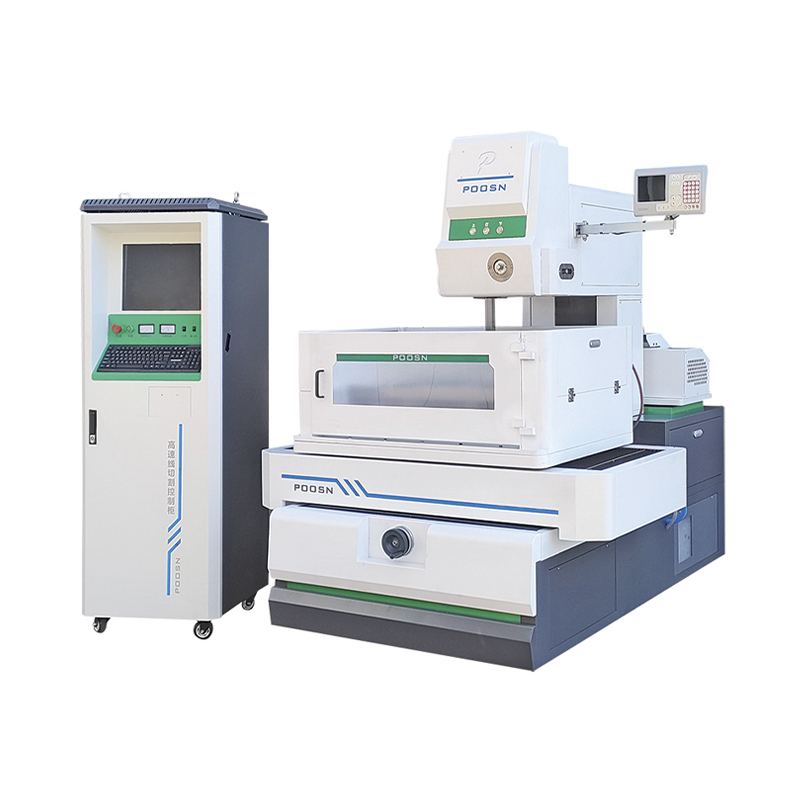
POOSN, the brand of Taizhou Xinchengyang Machinery Manufacturing Co., Ltd, has been building wire cut EDM equipment since 1999 and manufactures the machines itself rather than assembling from purchased sub-frames. Its range is organised into four lines: the PSC series medium speed wire cut EDM machine, the DK-BC series high-medium speed WEDM, the DKD series large taper cutting machine and the DK77 series high speed WEDM.
The core conclusion: hardness does not stop wire EDM, it only changes the cutting parameters. Once a part is hardened, wire EDM is often an effective choice for holding a tight tolerance on a complex profile without introducing new mechanical stress.
Content
- 1 Why Wire EDM for Hardened Steel Solves Problems Milling Cannot
- 2 How the Wire EDM Process Removes Hardened Steel
- 3 Hardened Steel Grades and How They Behave Under the Wire
- 4 Tolerances, Surface Finish and Multi-Cut Strategy
- 5 Matching the Machine to the Job: High Speed, Medium Speed and Large Taper WEDM
- 6 Wire Electrode Selection for Hardened Steel
- 7 Troubleshooting: Five Problems That Show Up on Hardened Work
- 8 Cost, Lead Time and How to Evaluate a Wire EDM Manufacturer
- 9 FAQ: Wire EDM for Hardened Steel
- 9.1 Can wire EDM cut steel that is already hardened to 60 HRC?
- 9.2 Does wire EDM for hardened steel require a different machine from soft steel work?
- 9.3 How accurate is wire EDM on hardened steel compared with soft steel?
- 9.4 Should I harden the part before or after wire cutting?
- 9.5 What wire should I use for hardened steel above 58 HRC?
- 9.6 Can wire EDM cut cemented carbide and other very hard materials?
- 9.7 Can POOSN provide a cutting test for hardened steel?
- 9.8 How do I choose the right POOSN machine for hardened steel?
- 10 Need to Cut Hardened Steel to a Specific Tolerance?
- 11 Where to Go Next
Why Wire EDM for Hardened Steel Solves Problems Milling Cannot
Four properties separate wire EDM from mechanical cutting, and each one matters more as hardness rises.
No cutting force. A milling cutter pushes against the workpiece with hundreds or thousands of newtons; a wire electrode exerts essentially nothing beyond the small hydrodynamic force of the flushing jet. Thin walls, slender cores and parts held by a few millimetres of material survive the cut without springing or collapsing. A 1.5 mm wide hardened rib that would snap under a milling cutter is simply cut through by the wire.
Independence from hardness as a cutting criterion. EDM removes material by melting and vaporising a tiny volume at the spark point, so the energy required depends on the steel's thermal properties and alloy content far more than on its Rockwell hardness. Moving from 45 HRC to 60 HRC on a comparable alloy costs a fraction of the speed a machining centre would lose — a change in cycle time, not in feasibility. How large that fraction is depends on the alloy, the section thickness and the flushing conditions, which is why a cutting test on the actual workpiece is worth more than any published figure.
The ability to cut after heat treatment. A die cavity milled soft and then hardened will move. A cavity hardened first and then wire cut to final dimensions holds the drawing tolerance because the distortion has already happened. Combined with vacuum hardening and a stabilising temper, a hardened profile typically lands close to the drawing without manual fitting.
Geometric reach. Wire EDM cuts a two-dimensional contour of arbitrary complexity through the full thickness of the workpiece, and with taper capability it can also produce draft angles, relief and clearance in the same setup. An inside corner comes out with a radius equal to the wire radius plus the spark gap, so a sharp internal corner in 60 HRC steel can be produced in the hardened state without hand polishing.
- No mechanical force, so thin and fragile hardened features survive the cut.
- Hardness changes the feed, not the feasibility.
- Cutting after hardening removes heat treatment distortion from the tolerance chain.
- Complex internal profiles are cut in one setup with no special tooling.
If a hardened steel feature has a tight tolerance and a complex outline, wire EDM can reduce secondary operations and total processing cost, because it removes hand fitting, secondary grinding and the risk of scrapping an expensive part late in the routing.
How the Wire EDM Process Removes Hardened Steel
A thin wire electrode, typically between 0.10 mm and 0.30 mm in diameter, is fed through the workpiece under tension. Wire and workpiece are submerged in deionised water acting as the dielectric, and a servo-controlled power supply applies a pulsed voltage between them. When the gap reaches roughly 0.01 to 0.05 mm the dielectric breaks down and a discharge channel forms, reaching several thousand degrees Celsius for a few microseconds and melting a microscopic crater of steel. The pulse ends, the channel collapses, the water jet flushes the debris away, and tens of thousands of these discharges per second advance the wire along the programmed path.
For hardened steel the important consequence is the recast layer left at the cut surface. This layer, sometimes called the white layer, is typically 2 to 20 micrometres thick depending on the roughing pulse energy. It is harder and more brittle than the parent metal and can carry tensile residual stress. A single roughing pass leaves it in place; a multi-cut sequence removes it, because each successive trim pass uses lower energy and a smaller offset increment until the final pass removes only a few micrometres and leaves a compressive or neutral surface.
Three machine parameters decide whether the process stays stable in hardened material. Wire tension must be high enough to resist the electrostatic and hydrodynamic forces that push the wire off the programmed path; low tension produces taper error and corner rounding. Flushing must be adequate, because trapped debris causes secondary discharges that erode the wire and the workpiece surface. And thermal stability must be controlled, because a workshop that swings five degrees between morning and afternoon will not hold a tight tolerance on a long part.
The recast layer is the hidden variable in hardened steel work: if a part will see fatigue or impact loading, specify a multi-cut sequence that removes it rather than accepting a single roughing pass.
Hardened Steel Grades and How They Behave Under the Wire
Not all hardened steel cuts the same way. Alloy content, carbide volume and the uniformity of the microstructure all influence how the spark behaves and how much wire you consume. The table below groups the materials most often quoted for hardened work by cutting behaviour.
| Material | Typical hardness | Cutting behaviour | Practical notes |
|---|---|---|---|
| H13 / SKD61 | 48 to 54 HRC | Relatively fast | Hot work die steel, cuts comfortably, common in die casting tooling |
| A2 / SKD12 | 58 to 62 HRC | Relatively fast | Uniform structure, predictable, a good choice for first-time hardened work |
| 440C stainless | 56 to 60 HRC | Fast to moderate | Watch for corrosion if parts sit wet between operations |
| D2 / SKD11 | 58 to 62 HRC | Moderate | Large chromium carbides cause localised wire wear; expect higher wire consumption |
| Ti-6Al-4V | 33 to 38 HRC | Moderate | Cuts well but tends to form a heavier recast layer |
| M2 high speed steel | 62 to 65 HRC | Moderate | High alloy content; reduce roughing energy to protect the wire |
| Powder metallurgy HSS | 64 to 67 HRC | Slow | Very uniform but very hard; slow roughing, excellent finish after trims |
| Inconel 718 | 40 to 45 HRC | Slow | Aerospace work; high toughness, slow roughing, frequent flushing checks |
| Cemented carbide | 88 to 92 HRA | Slowest | Cobalt binder erodes preferentially; dedicated settings recommended |
The ranking between grades is the part that carries across shops. The exact speed difference between two materials depends on workpiece thickness, flushing conditions and the number of trim passes specified, so confirm it with a cutting test on the actual material rather than assuming it from any table, including this one.
Thickness compounds everything: a 20 mm section flushes easily and cuts near its nominal rate, while a 120 mm section traps debris in the kerf and forces the operator to reduce pulse energy. On tall hardened blocks, wire diameter and nozzle condition matter more than the machine's headline specification.
Quote hardened D2, PM steel and carbide jobs separately from A2 and H13 work; the difference in cutting behaviour and wire consumption between them is large enough to turn a profitable job into a loss.
Tolerances, Surface Finish and Multi-Cut Strategy
Hardened steel does not cut at a single speed: the same block that runs comfortably at one pulse setting will stall the servo or break the wire at another. A hardened job is therefore never quoted from one speed figure, and the parameters have to be tuned to the material rather than copied from a soft steel job.
Above roughly 58 HRC most tool steels are heavily alloyed with chromium, molybdenum, vanadium or tungsten, and those carbides have higher melting points and higher thermal conductivity than the surrounding matrix. Each discharge removes slightly less volume, and the wire wears faster because the carbides abrade it as the kerf closes behind the cut. The drop in cutting rate is gradual across the pre-hardened range and steepens sharply in the last few points of hardness, which is where cost estimates usually go wrong.
Trim passes are the other half of the time calculation. A pre-hardened mould plate is often cut with one roughing pass and one skim; a hardened punch and die set that must hold a tight tolerance and a fine surface may need three or four trims. On a tall profile those trims can add a substantial share of the total cutting time even though they remove only hundredths of a millimetre, so when a supplier quotes a cutting speed, confirm whether it covers the roughing pass alone or the complete sequence.
Achievable accuracy is best treated as a range to be verified rather than a specification to be quoted. Depending on the machine configuration, workpiece geometry, material condition and cutting strategy, wire EDM can achieve different levels of dimensional accuracy; for critical hardened-steel parts, a cutting test under the intended machining conditions is recommended. Corner accuracy is generally wider than straight wall accuracy because the wire has to decelerate and reverse direction, and the smallest achievable internal radius is roughly half the wire diameter plus the spark gap.
Surface finish behaves in the same direction: each trim pass lowers the roughness value, but the last passes add time without changing the geometry much, so the finish specified should be the finish the part needs. POOSN's parameter tables document Ra ≤ 1.2 μm with multi-cutting on the PSC series and Ra ≤ 2.5 μm on the DKD large taper series, measured under normal production conditions.
Plan hardened steel jobs around the full multi-cut sequence, not the roughing speed alone: above 58 HRC the cutting rate falls steeply, and the trim passes that produce the required finish and remove the recast layer can add a large share of the cycle time.
Matching the Machine to the Job: High Speed, Medium Speed and Large Taper WEDM
Hardened steel work spans a wide range of requirements, and no single configuration covers all of them economically. The four families most commonly used differ in wire travel system, achievable accuracy and taper capability.
- PSC series (PSC35C, PSC45C, PSC50C, PSC60C). Medium speed machines with a wire drum system and multi-cut capability, the accuracy tier used for hardened die and mould inserts.
- DK-BC series (DK35BC, DK45BC, DK50BC). A bridge between economy and precision for mixed production.
- DKD series (DK45D, DK55D, DK63D, DK80D). Large taper cutting for draft, relief and clearance features.
- DK77 series (DK7725, DK7745, DK7745F, DK7780). Reciprocating molybdenum wire, the economic workhorse for general hardened steel cutting.
Medium speed machines are the natural choice for hardened die and mould work where tolerance matters. The electrode wire is carried on a drum and travels back and forth through the kerf, so the same wire is used across the roughing and trim passes instead of being discarded after a single pass. That keeps consumable cost low and lets a multi-cut sequence run on one wire, but it puts the wire under repeated load, so diameter, tension and surface condition have to be monitored and the wire replaced on a schedule. Documented figures for the PSC series include a 0.18 mm electrode wire with a wire guide, 180 mm of wire drum travel, a maximum wire storage length of approximately 320 m and Ra ≤ 1.2 μm with multi-cutting. If your typical job is a 60 HRC punch, a complex die insert or a fine-ribbed core, this is the tier to specify; the PSC45C covers most hardened mould insert sizes.
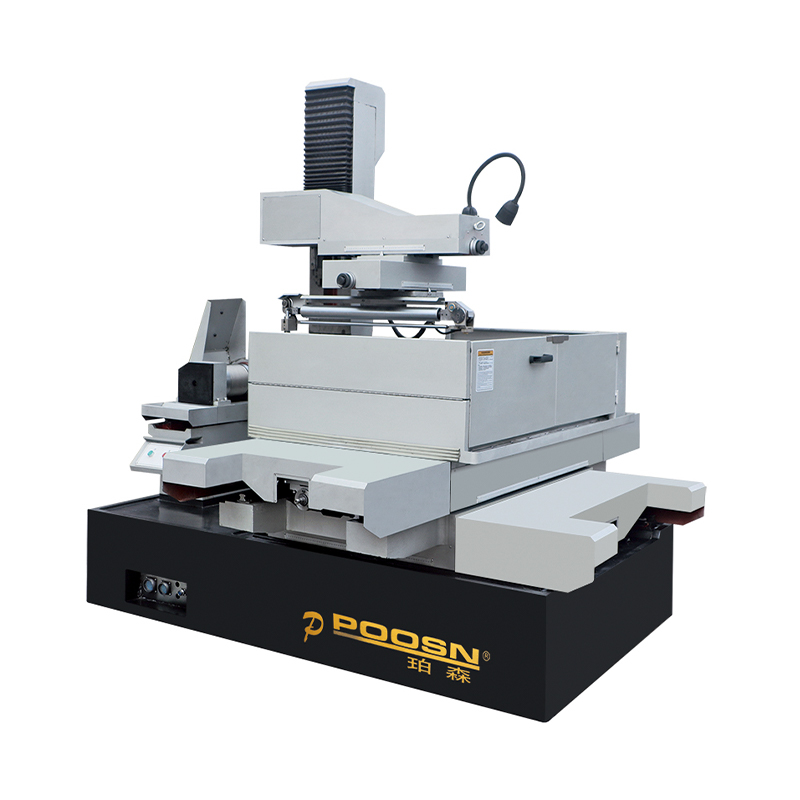
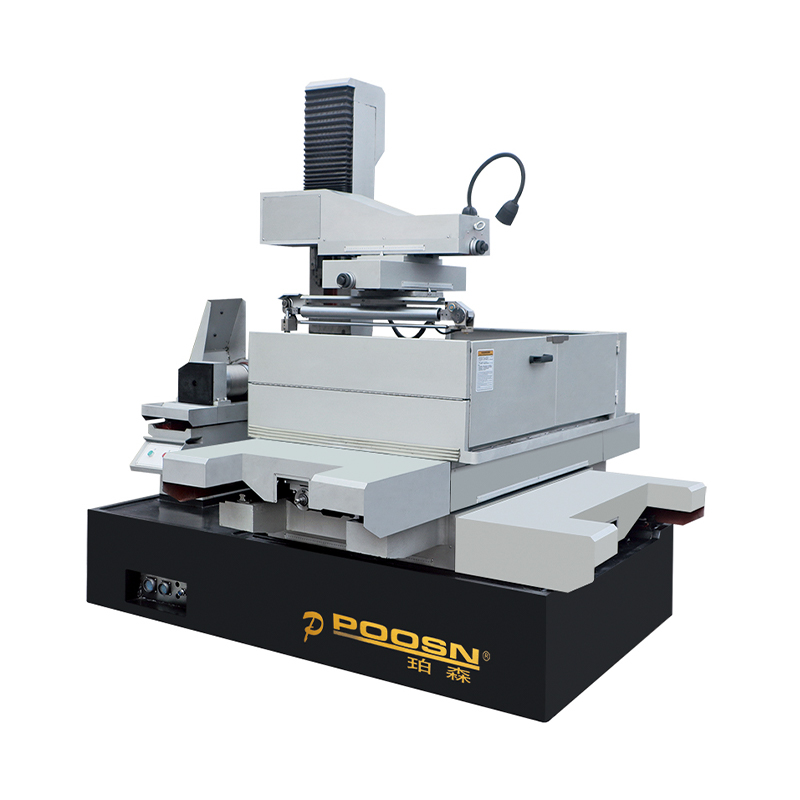
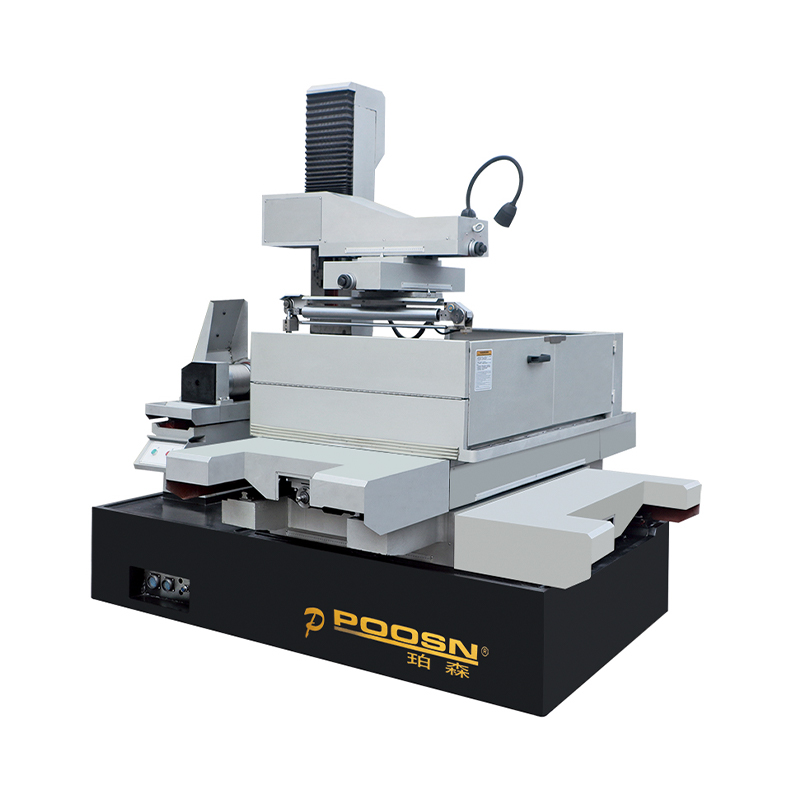
High speed machines cost less to buy and less to run, because the molybdenum wire is reciprocated and reused rather than replaced. The trade-off is accuracy and surface finish: a single pass holds a considerably wider tolerance band and a rougher surface than a multi-cut medium speed machine, which is adequate for blanking dies, electrode blanks, fixture plates and general toolroom work where a fitter closes the last few hundredths of a millimetre. The DK77 series documents Ra ≤ 2.5 μm and a maximum cutting taper of ± 6°/80 mm on the DK7745, with X, Y, U and V axes linked in four-axis mode.
Large taper machines enter the picture whenever the hardened part needs angular geometry: draft on a die casting insert, relief behind a cutting edge or clearance on a punch all require the upper wire guide to offset from the lower one while the cut is running. The DKD series covers cutting tapers from ± 30° to ± 45° at 40 to 80 mm of taper height, depending on the model. Taper cuts in hardened steel are more demanding than in soft steel because the wire travels a longer path through a harder material and the flushing at the angled face is worse, so a rigid, well-compensated taper head makes a measurable difference. The DK45D is the entry model in this series.
Workpiece size should drive the final decision more than any specification sheet number: a machine with a 400 by 500 mm worktable will not accept a 700 mm die block no matter how accurate it is, and moving a large hardened block to a second machine for a finishing pass costs more than specifying the right table size in the first place. Measure the largest part you expect to cut over the next three years, add 20 percent, and specify from there.
Match the machine class to the tolerance, not to the price: medium speed for hardened inserts that must hold a tight band with multi-cut, high speed for general hardened cutting where a fitter closes the last few hundredths of a millimetre.
Machine reference
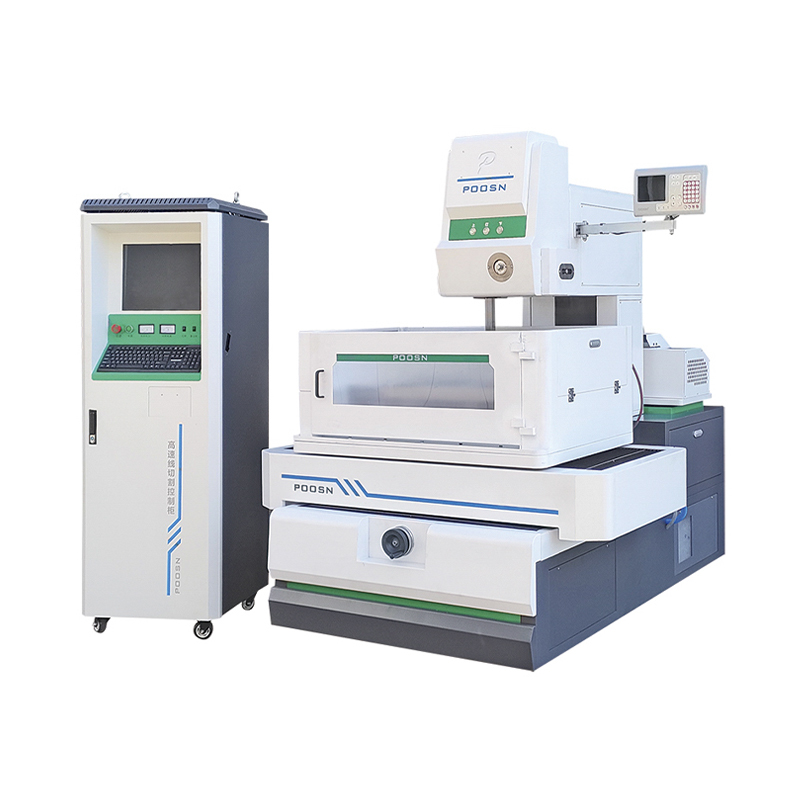 PSC45C Medium Speed Wire Cut EDM MachineMid-range PSC model with a 0.18 mm electrode wire, 180 mm wire drum travel and multi-cut control.View Product →
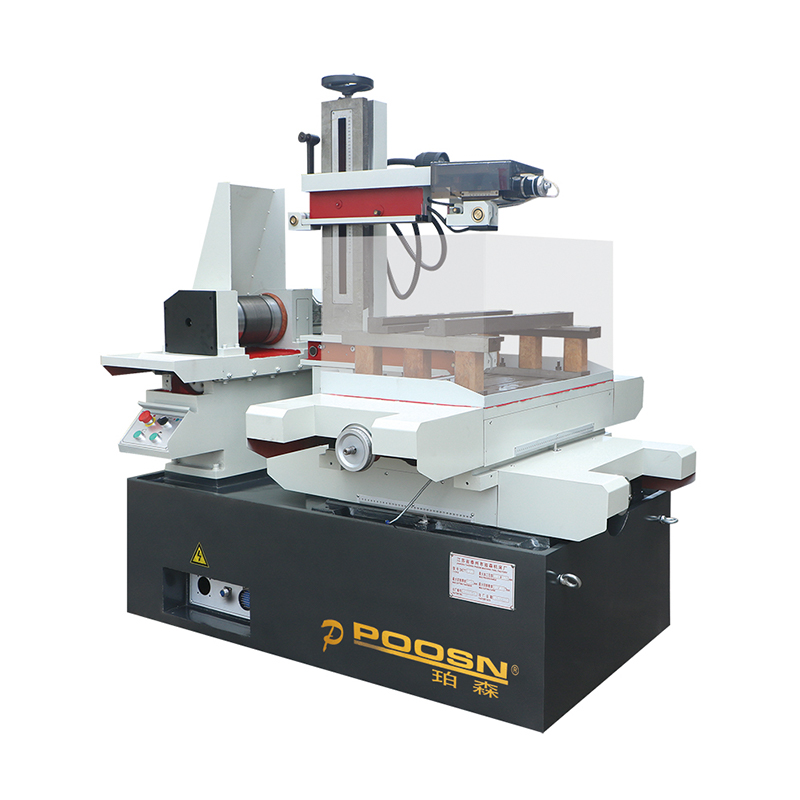 DK7745 High Speed Wire Cut EDM MachineFour-axis (X, Y, U, V) reciprocating molybdenum wire machine for general hardened cutting and electrode blanks, documented at Ra ≤ 2.5 μm.View Product →
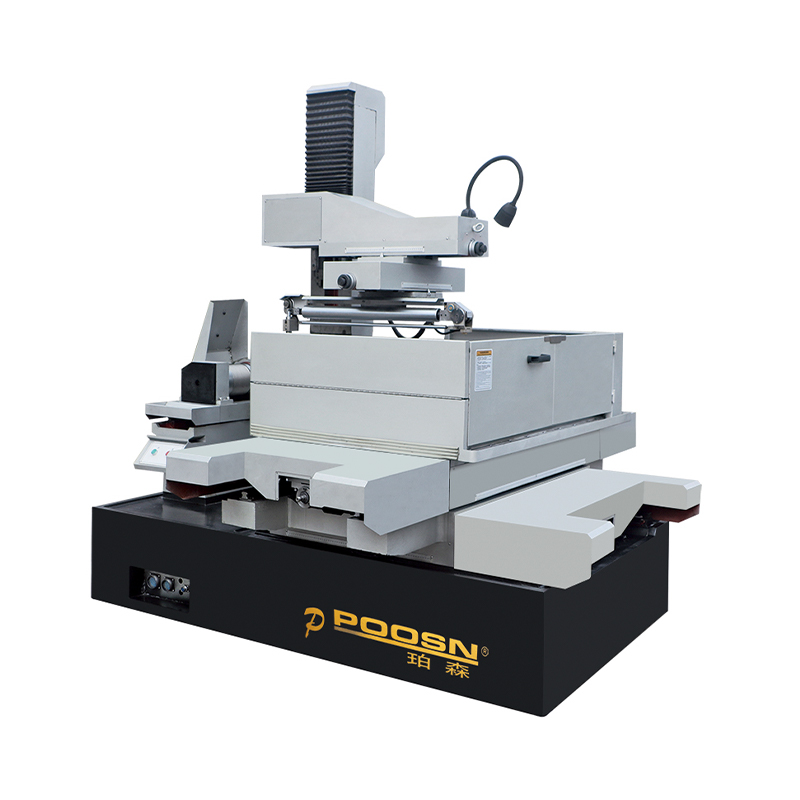 DK45D Large Taper Wire Cut EDM MachineEntry model in the DKD large taper series, built for draft, relief and clearance features on hardened inserts and punches.View Product →
Wire Electrode Selection for Hardened Steel
The wire is the tool, and on hardened work it is also a common cause of unexpected cost and downtime. Which wire is correct depends on the machine's wire travel system as much as on the material being cut.
Molybdenum wire is the standard electrode on reciprocating machines, which is the configuration used across the POOSN range. It has a high melting point, good tensile strength at small diameters, and it can be reused for many passes before replacement. Typical diameters run from 0.12 mm to 0.20 mm, with 0.18 mm specified on the PSC and DKD series. Because the wire is reused, its diameter and surface condition have to be monitored: a worn wire produces a wider kerf, a poorer surface finish and a growing risk of breakage in the middle of a long cut.
Zinc-coated and diffusion-annealed brass wire is the standard electrode on unidirectional machines, the low-speed WEDM class in which the wire passes through the workpiece once and is discarded. The coating vaporises at a lower temperature than the brass core, which cools the discharge zone and extends wire life under load. On a unidirectional machine, coated brass is normally the better choice in hardened tool steel; on a reciprocating machine the wire has to survive repeated passes, which is why molybdenum is specified instead.
- Set wire tension at the upper end of the recommended range for tall hardened blocks.
- Step down in diameter only when the internal corner radius on the drawing requires it.
- Replace wire on a fixed schedule rather than on visible failure.
- Store wire in dry conditions; moisture degrades coated wire before it ever reaches the machine.
Wire diameter and workpiece thickness interact in a way that is easy to overlook. A small wire cuts a finer corner but has less tensile strength and a smaller cross-section to carry current, so it cannot run at the pulse energy a larger wire handles and on a tall block it will be both slow and fragile. If the drawing demands a small corner radius on a tall part, it is often better to cut that radius in the soft state, harden, and then wire cut only the critical profile with a larger wire. The EDM wire material guide covers the selection logic in more detail.
On hardened steel above 55 HRC the wire is not a commodity: matching wire type and diameter to the machine's wire travel system and to the required corner radius is what keeps both cutting speed and breakage under control.
Troubleshooting: Five Problems That Show Up on Hardened Work
Most problems on hardened steel trace back to one of five causes. Working through them in order saves time.
Wire breakage in the middle of a cut. Check flushing first, then wire tension, then pulse energy. Hardened material produces more debris per unit of length, and if the flush is weak the debris bridges the gap and causes a short that snaps the wire. Reduce roughing energy one step before changing anything else.
Cutting speed dropping as the cut progresses. Usually a flushing problem that develops with depth, or a worn wire on a reciprocating machine. Verify nozzle pressure, check that the workpiece is not blocking the lower flush, and measure the wire diameter if it is reused.
Taper error or barrelling on the wall. The wire is being pushed away from the programmed path. Increase tension, reduce the cutting energy on the finishing passes, and check the guide alignment. On tall parts a small tension deficit produces a surprisingly large deviation at mid-height.
Surface cracking or a heavy white layer. The part was cut with a roughing pass only, or the trims ran at too high an energy. Add a finishing pass at low energy and confirm that it removes at least 5 to 10 micrometres from the wall; fatigue-critical components should not be finished on a single pass.
Rust on the cut faces. Deionised water leaves the workpiece wet, and hardened tool steel with a freshly cut surface flashes rust within hours in a humid shop. Dry the part, apply a light oil or rust inhibitor, and do not leave finished dies on the machine overnight.
Two further items deserve routine attention even when nothing appears to be wrong. Guide wear changes the wire position by a few micrometres and gradually degrades corner accuracy, so guides should be inspected on a fixed interval rather than replaced on failure. Dielectric water conductivity should be logged: when it drifts upward the discharge becomes unstable and the finish deteriorates, and the operator usually blames the wire when the water is the real cause.
On hardened steel, flushing instability causes more problems than any other single factor: before adjusting the power settings, verify the water quality, nozzle pressure and guide condition.
Cost, Lead Time and How to Evaluate a Wire EDM Manufacturer
The purchase price of a wire cut EDM machine is only one part of the decision, and on hardened steel work it is rarely the largest part. Running cost, uptime and the supplier's ability to support the machine over a ten-year service life determine the real number.
Operating cost breaks down into wire consumption, dielectric water treatment and filters, electrical power, labour and maintenance. On a medium speed machine cutting hardened steel, wire is usually the largest single consumable, followed by filters and resin. A machine that cuts faster but consumes more wire may not be cheaper to run, so ask for a consumption estimate based on a specific part rather than a generic speed figure.
Lead time matters too: a supplier who quotes twelve weeks and delivers sixteen has cost the buyer a customer, particularly when a new die programme is on the line. Ask for a documented delivery commitment, and check whether the manufacturer builds the machine itself or assembles from purchased sub-frames — a direct manufacturer controls more of the schedule, which shows up when a custom configuration or an OEM specification is involved.
For buyers sourcing from overseas, three practical points reduce risk. Confirm the electrical configuration, including voltage, phase and frequency, before shipment, because a machine built for one grid may need a transformer in another. Ask for the packing specification and confirm that the wire guides and taper head are protected for sea freight. And agree a commissioning plan in writing: the first hardened steel job run on a new machine reveals more about the setup than any acceptance certificate.
| What to ask | What a good answer looks like |
|---|---|
| Are you the manufacturer or a trading company? | A clear statement of factory ownership, with a site visit or video walkthrough available |
| What is the demonstrated accuracy on hardened steel? | Positioning accuracy figures plus a sample part cut in 60 HRC material |
| How long has the company been building EDM machines? | A continuous history in wire cut EDM rather than recent entry into the category |
| Can the machine be configured for our part size? | Specific travel dimensions matched to the largest workpiece in the drawing pack |
| What consumables does the machine require? | A named list of wire diameter and type, filter part numbers and resin specification |
| What spare parts are held in stock? | Guides, nozzles, power boards and pumps available without a long lead time |
| Is customisation or OEM branding available? | Documented capability to modify control, table size or taper head for a specific requirement |
| What training and documentation are included? | On-site commissioning, operator training and a manual in the buyer's language |
| How are warranty claims handled? | A named contact, a defined response time and remote diagnostics support |
Evaluate a wire EDM supplier against your hardest recurring job, not your easiest one: accuracy margin, consumable cost and spare part availability decide whether the machine is still profitable in year five.
FAQ: Wire EDM for Hardened Steel
Can wire EDM cut steel that is already hardened to 60 HRC?Yes, and this is one of its main advantages. The process removes material by electrical discharge rather than by a cutting edge, so 60 HRC steel is cut routinely. Expect the cutting rate to fall and wire consumption to rise compared with a pre-hardened block of similar composition, because the higher alloy content abrades the electrode; how much depends on the material, thickness and flushing, so a cutting test on your workpiece is the reliable way to quote it. |
Does wire EDM for hardened steel require a different machine from soft steel work?No. The same machine cuts both, but the parameter set changes: hardened material needs lower roughing energy, higher wire tension, more attention to flushing and usually one or two additional trim passes to remove the recast layer. Shops that cut a lot of high hardness work sometimes dedicate a machine to it so that the settings are not disturbed by frequent switching. |
How accurate is wire EDM on hardened steel compared with soft steel?The achievable accuracy is essentially the same, because the machine's positioning system and the wire's thermal stability do not depend on workpiece hardness. What changes is the risk profile: hardened steel is more sensitive to wire vibration and to secondary discharges from trapped debris, so the practical tolerance band may widen slightly if flushing is marginal. |
Should I harden the part before or after wire cutting?For any feature with a tight tolerance, harden first and wire cut afterwards. Heat treatment causes dimensional movement that no machining strategy can predict precisely, so cutting before hardening means the finished feature will drift. Cutting after hardening puts the last operation on the finished geometry and removes distortion from the tolerance chain. The exception is a corner radius smaller than the wire can produce, which is sometimes cut soft and finished after hardening. |
What wire should I use for hardened steel above 58 HRC?It depends on the machine's wire travel system. On a reciprocating machine, which is the configuration used across the POOSN range, the electrode is molybdenum wire in 0.12 to 0.20 mm, normally 0.18 mm, replaced on a fixed schedule rather than on visible failure. On a unidirectional low-speed machine, a zinc-coated or diffusion-annealed brass wire is the standard starting point and cuts faster and breaks less often than plain brass in high hardness material. Step down in diameter only when the internal corner radius on the drawing requires it. |
Can wire EDM cut cemented carbide and other very hard materials?Yes. Carbide gives a lower cutting speed, higher wire consumption and a rougher roughing surface because the cobalt binder erodes preferentially, so dedicated settings are recommended and many shops keep a specific machine for it to keep cobalt and tungsten debris out of the dielectric. |
Can POOSN provide a cutting test for hardened steel?Yes. Send the material grade and hardness, the workpiece thickness, and the drawing with the required tolerance and surface roughness. POOSN will review the geometry against the machine's travel and taper capability, agree a test plan, and cut the part so that both sides have measured results before a configuration is confirmed. |
How do I choose the right POOSN machine for hardened steel?Work from the part, not from the specification sheet: the largest workpiece dimensions and weight, the material and hardness, the tolerance and surface finish the drawing requires, and the taper angle and height if the part needs angular geometry. Those inputs point to a series: PSC for hardened inserts that need multi-cut accuracy, DK-BC where economy and precision have to be balanced, DKD where large taper features are involved, and DK77 where general hardened cutting and low running cost matter most. |
Need to Cut Hardened Steel to a Specific Tolerance?
Send POOSN your part drawing, material grade, workpiece thickness and required tolerance. Our team can review your application and discuss a suitable machine configuration and cutting test.
Where to Go Next
Two resources on this site extend the topics above: the wire EDM solutions for mold manufacturing page covers how these machines are applied in die and mould production, and the EDM wire material guide covers electrode selection on high hardness material. The PSC, DK77 and DKD series category pages list the models, travel sizes and taper options referred to in this guide.
POOSN builds the PSC medium speed series, the DK-BC high-medium speed series, the DKD large taper series and the DK77 high speed series at its facility in Taizhou, China. Enquiries about a specific hardened steel application are welcome, and a quotation can be prepared against a drawing, a material specification, and the required tolerance and surface finish.
Hardened steel is not a difficult material for wire EDM; it is the material the process was developed for. The hardness that stops a milling cutter and ruins a grinding wheel simply changes the pulse settings and the number of trim passes. What decides whether a hardened job runs profitably is the same set of factors that govern any EDM operation: adequate flushing, correct wire tension, a stable thermal environment, a wire matched to the material, and a machine class sized to the tolerance the drawing specifies.
Cut after hardening, specify the right machine class, and treat flushing and wire selection as process variables rather than consumable afterthoughts: that combination is what makes wire EDM for hardened steel both accurate and repeatable.

-
Phone
+86-0523-86268788 +86-13815960366 +86-13912191163Email
[email protected]Address
No. 366, Yusheng Road Jiulong Town, Hailing District Taizhou City, China
Copyright © Taizhou Xinchengyang Machinery Manufacturing Co., Ltd. All Rights Reserved.
Custom edm machine for sale
wholesale edm machine manufacturers
