

 English
 русский
 عربى


Industry News
Home / News / Industry News / Wire EDM for Mold Making: Accuracy, Taper, and Machine Selection Guide
Wire EDM for Mold Making: Accuracy, Taper, and Machine Selection Guide
2026-10-27
A die-cast insert leaves the machining center with 0.25 mm of stock on every wall, two 0.8 mm rib slots, and a parting line that has to close inside 0.01 mm. No end mill reaches the internal corner, and no grinder follows that profile without a custom form wheel. This is the moment when wire EDM for mold making stops being a secondary operation and becomes the step that decides the delivery date.
The practical conclusion first: choose the machine by the tolerance and the taper you must hold on hardened steel, not by the cutting rate printed on the brochure. Mold work rewards multi-cut capability, stable flushing and thermal discipline far more than raw square millimeters per minute. Machine class, the number of trim passes, and wire and water quality set the achievable result together, and the machine only defines the ceiling.
In mold shops, the wire EDM is a precision finishing instrument; buying it as a fast cutter usually costs more in bench work than it saves in cycle time.
Content
- 1 Why Wire EDM Sits at the End of the Mold Process Chain
- 2 How a Wire Cut EDM Machine Actually Removes Metal
- 3 Choosing Wire EDM for Mold Making: Matching Machine Class to the Work
- 4 Taper and Workpiece Thickness: The Two Numbers Mold Makers Underestimate
- 5 Tolerance Budgets by Machine Class: Reading the Numbers on a Real Mold
- 6 Wire, Flush and Fixturing: Where Accuracy Actually Comes From
- 7 A Selection Checklist for Buying a Mold-Making WEDM
- 8 Cost and Cycle Time: The Multi-Cut Decision in Real Numbers
- 9 Commissioning and Maintenance: Keeping Tolerance After Year One
- 10 Sourcing: What to Ask a Wire EDM Manufacturer or Supplier
- 11 Frequently Asked Questions About Wire EDM for Mold Making
- 11.1 Can wire EDM for mold making hold ±0.005 mm on a hardened insert?
- 11.2 Which wire diameter should a mold shop run?
- 11.3 Is medium-speed or high-speed wire EDM better for mold making?
- 11.4 How much stock should be left before the wire cut?
- 11.5 Does the recast layer affect polishing?
- 11.6 What taper angle do mold shops actually need?
- 11.7 How do I compare wire EDM machine price across suppliers?
- 12 Explore Further
Why Wire EDM Sits at the End of the Mold Process Chain
Mold manufacturing has a fixed sequence: rough mill, stress relieve, semi-finish, heat treat, then finish. Wire EDM belongs to the last stage, for a simple reason. It does not care how hard the workpiece already is. A 58 HRC insert and an annealed block cut the same way, because the process removes material with electrical discharges instead of a cutting edge.
That property alone justifies the machine in most shops. The more valuable arguments, however, are geometric:
- Sharp internal corners. The smallest inside radius a wire can produce is roughly the wire radius plus the spark gap, so a 0.25 mm wire delivers a corner under 0.2 mm. Milling cannot reach that without leaving a relief or a tool mark.
- No cutting force. Thin ribs, tall cores and narrow slots do not deflect, so you can cut features that would chatter or spring under an end mill.
- No grinding burn. Carbide and powder metallurgy inserts, notorious for heat checking during grinding, are cut cleanly with no mechanical load at all.
- Closure-critical details. Parting lines, shut-off faces, ejector pin bores, gate inserts and slide faces are usually finished on the wire because the tolerance depends on machine position rather than operator feel.
- Repeatability across a batch. Once the program and the offsets are proven, insert number two and insert number twelve come out the same, which matters when a mold ships with spares.
The limits matter just as much as the benefits. Wire EDM cuts through-features only, so a blind pocket or a three-dimensional contoured cavity belongs to a die-sinking machine or a high-speed milling center. It is also slow over large areas, which means using it to remove 10 mm of stock wastes money. The healthy rule in most mold shops is to leave 0.2 to 0.5 mm of stock after heat treatment and let the wire take the rest.
Wire EDM earns its place as the finishing operation on hardened, thin-walled and corner-critical mold details, not as a roughing method.
How a Wire Cut EDM Machine Actually Removes Metal
Inside the work tank, a wire electrode travels past the workpiece while deionized water floods the gap. Molybdenum wire is the standard choice on reciprocating high-speed machines, while brass or coated brass dominates medium-speed work. The generator applies pulses in the tens of thousands per second. Each pulse ionizes the water, forms a plasma channel and vaporizes a microscopic volume of steel, and the water carries the debris away before the next pulse arrives.
Nothing touches the workpiece, so the tool never wears mechanically, but it does wear electrically. That is why wire quality, wire tension and water condition dominate accuracy far more than the frame casting does. The same physics explains the pass structure that every precision wire EDM uses:
- Rough pass. Full power, fastest removal, and a recast layer of roughly 2 to 10 µm on the cut face.
- Trim passes. Lower energy, offset by a few micrometers each time, removing the damaged layer and correcting the profile.
- Skin pass. The final low-energy pass that brings surface finish from about Ra 2.5 µm down to Ra 0.4 µm or better and stabilizes the dimension.
One number deserves attention on the shop floor: the spark gap. On a typical rough cut it runs around 0.03 to 0.05 mm per side, and it changes with discharge energy, wire diameter and flush condition. Every CNC WEDM program compensates for it automatically, but if water conductivity drifts, the gap drifts with it, and the part lands at the edge of tolerance without anyone touching an offset.
Tolerance on a wire cut EDM machine is a system result — generator, wire, water and pass strategy — and no single component compensates for a weak link in the other three.
Choosing Wire EDM for Mold Making: Matching Machine Class to the Work
Most mold shops end up with two classes of machine rather than one. A fast single-pass machine handles parting lines, ejector bores, plate openings and tooling, while a multi-cut machine takes the inserts where the fit tolerance and the polished face actually matter. The table below is the shortcut version of that logic.
| Machine class | Typical tolerance | Typical finish | Best mold work | Watch-outs |
|---|---|---|---|---|
| High-speed WEDM, reciprocating molybdenum wire | ±0.015 to ±0.020 mm | Ra 2.5 to 3.2 µm | Parting lines, plate openings, ejector holes, shop tooling | Wire wear limits taper and finish consistency |
| High/medium-speed bridge class | ±0.010 to ±0.015 mm | Ra 1.6 to 2.5 µm | General inserts, slides, general-purpose mold plates | Flush quality and water maintenance decide the result |
| Medium-speed WEDM with multi-cut | ±0.003 to ±0.005 mm | Ra 0.4 to 0.8 µm | Cores, cavities, fine ribs, precision inserts, carbide | Thermal stability and pass discipline are non-negotiable |
| Large-taper WEDM | ±0.010 to ±0.015 mm at the quoted angle | Ra 2.0 to 3.2 µm | Draft faces, slides, angled shut-offs, deep tapered profiles | Angle accuracy falls off with workpiece height |
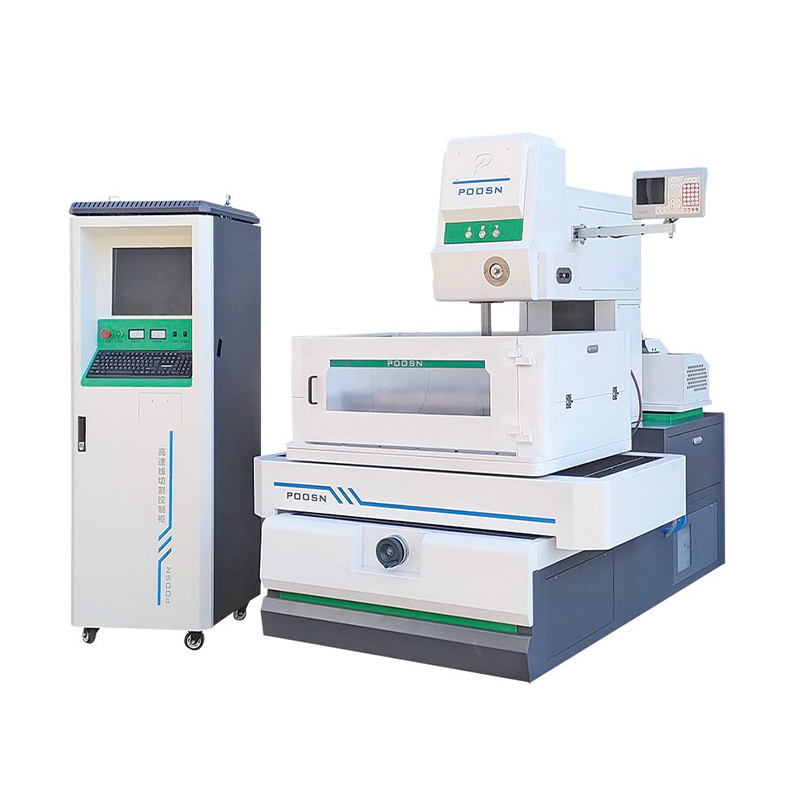
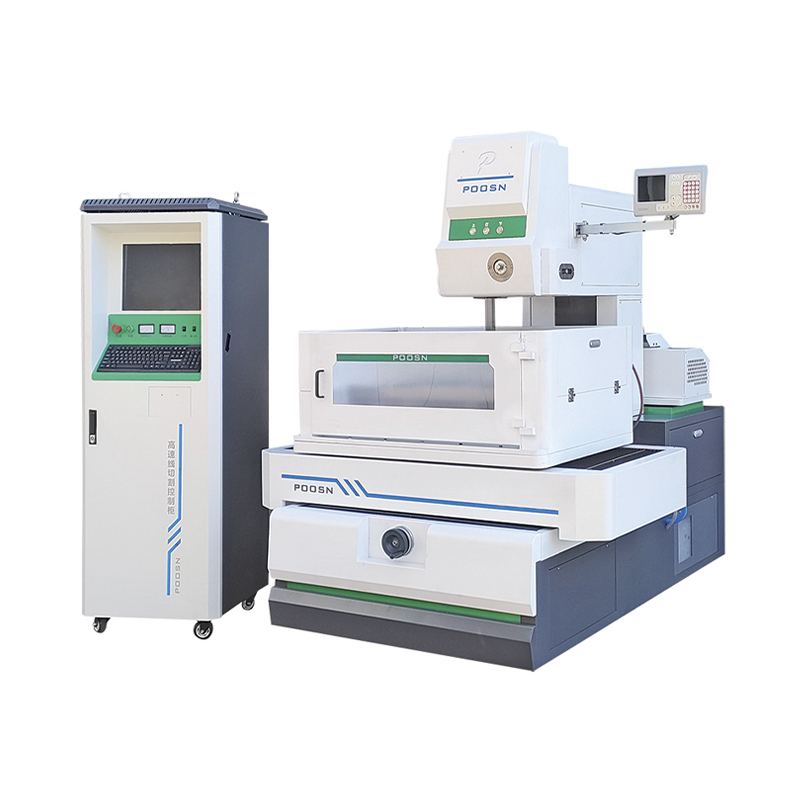
If the shop's core business is injection mold inserts with fits around ±0.01 mm, the PS-C medium-speed family is the working sweet spot. The series covers PS35C, PS45C, PS50C and PS60C, and all of them are built around multi-cut operation: one rough pass followed by two or three trims, which is what delivers sub-0.01 mm position and a surface a polisher can work with.
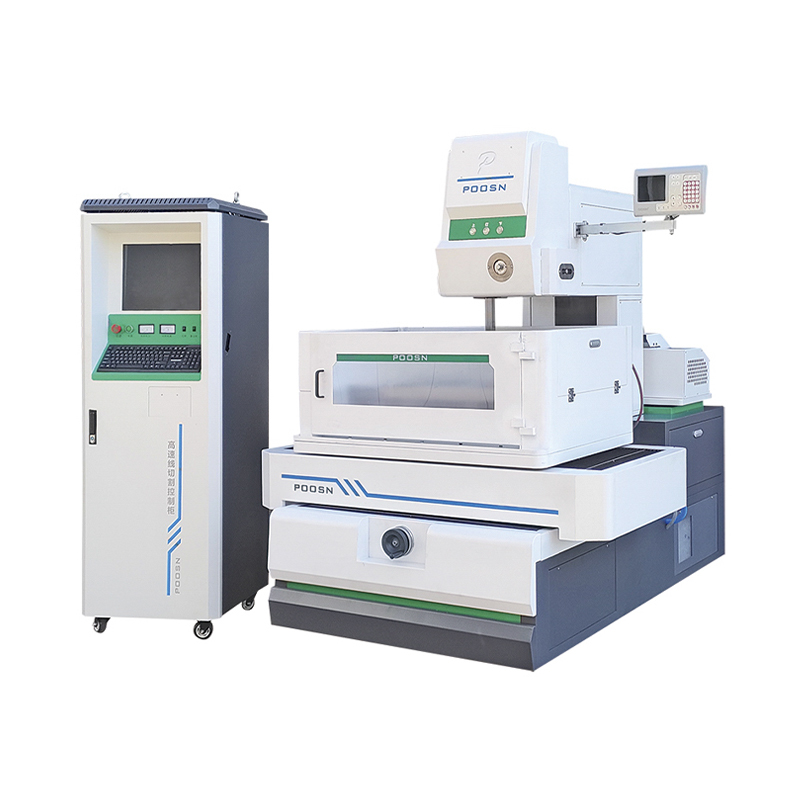 PS45C Medium-Speed Wire EDM for Mold InsertsA 45-size PS-C machine for shops cutting precision injection mold inserts, balancing multi-cut accuracy, worktable capacity and mid-size shop budget.View Product →
A 45-size machine covers a large share of automotive and consumer-goods insert work while keeping both footprint and capital cost inside a mid-size shop's budget. Shops that cut small precision inserts all day often pair it with a 35-size machine, and shops with large die blocks step up to the 50 or 60 size instead of pushing a small table past its stroke.
Match the machine class to the tightest fit and the largest workpiece in your order book, then let a second, faster machine handle the loose work.
Taper and Workpiece Thickness: The Two Numbers Mold Makers Underestimate
Draft angles are the quiet reason wire EDM shows up in shops that already own a die-sinker. One or two degrees of draft on a core, or a shut-off face that leans, is routine on a taper-capable machine and impossible on a machine limited to a fraction of a degree. Progressive die work adds a second reason: relief angles on punches and dies that must be cut in one setup to stay aligned.
Two figures define taper capability, and only one of them appears in the headline. The first is the maximum angle. The second is the workpiece height at which that angle is still held. A machine quoted at 30 degrees will usually maintain it at a stated height such as 80 or 100 mm, and loses accuracy as the block gets taller. Machines rated for 60 degrees cost more, but they pay back on deep cores, angled shut-offs and large-angle work where a second operation would otherwise be needed.
- Guide offset and wire tension both increase as the wire tilts, so the top and bottom of the kerf behave differently.
- Flushing degrades at the top of a deep taper, which is where wire breakage usually starts.
- Corner control needs a controller that adjusts power around the corner instead of running straight through it.
- Measurement must be done on a CMM at both faces; calipers at the top of a tapered wall tell you very little.
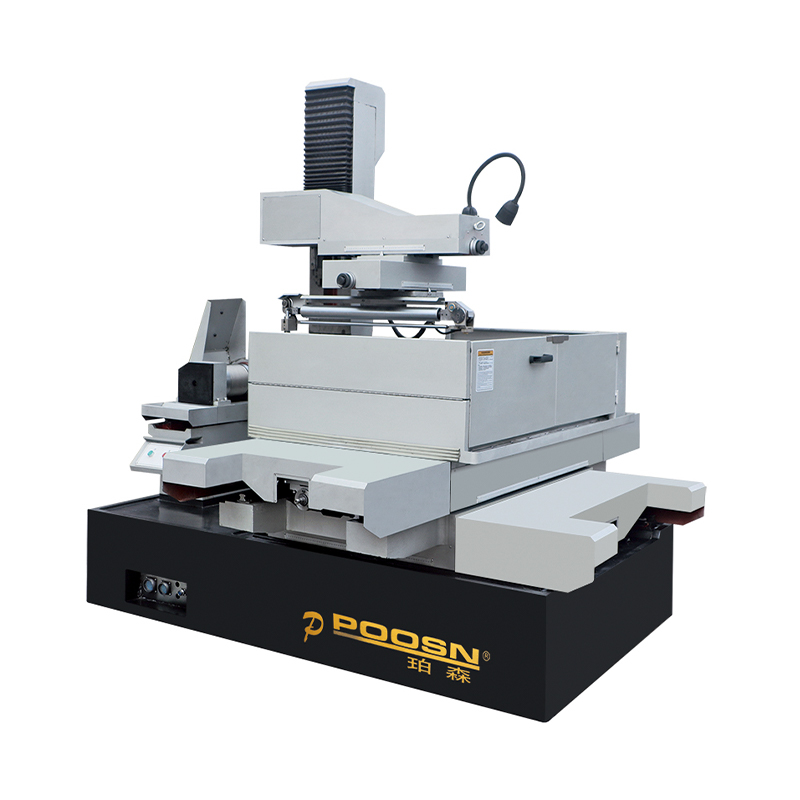
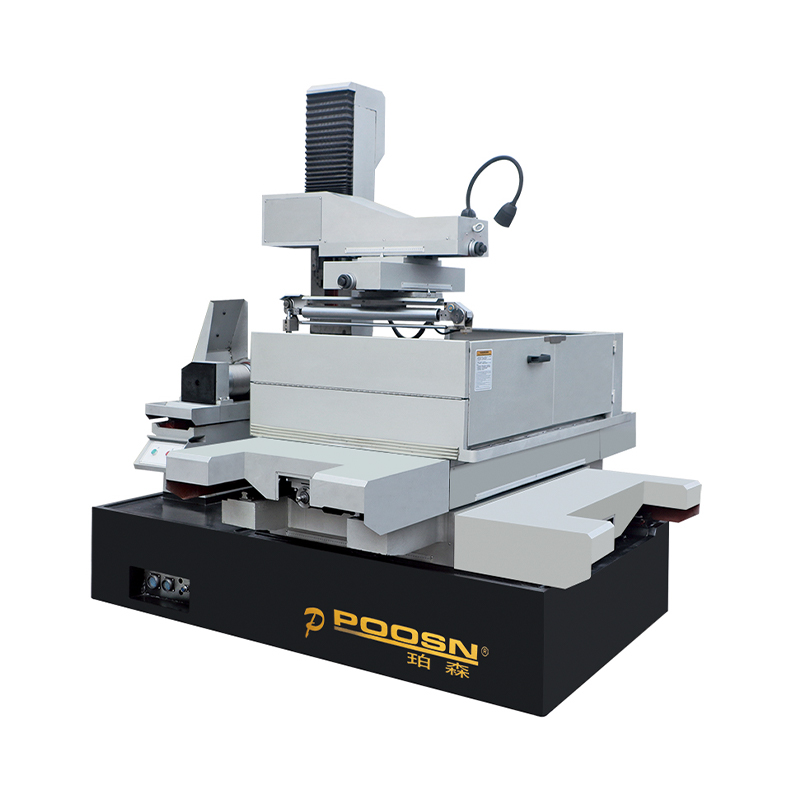
The DKD large-cutting taper family exists for exactly this job. DK45D, DK55D, DK63D and DK80D cover a wide size range, and the design focus is draft, angled faces and deep profiles on mold and die blocks where the angle is part of the drawing rather than an afterthought.
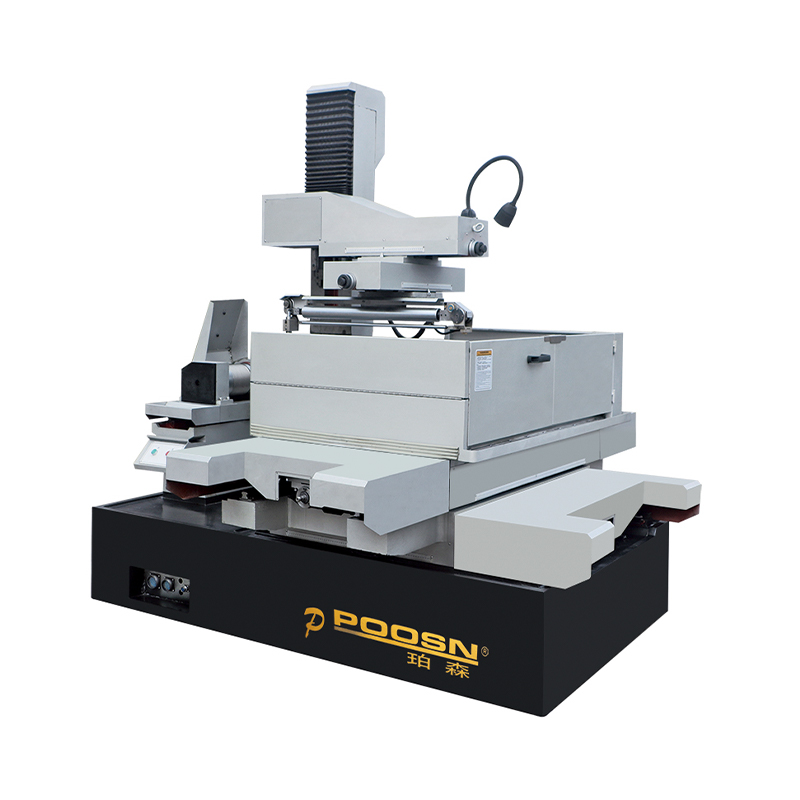 DK45D Large-Taper Wire EDM for Angled Mold WorkFor mold and die blocks with draft and deep angled profiles, this DKD model supports large taper cuts and complex spatial geometries.View Product →
During evaluation, request a test cut at the angle and height you will actually run, then check top and bottom dimensions properly. A machine that holds 30 degrees at 50 mm may not hold it at 200 mm, and that difference only reveals itself on the first deep core, when the mold is already late.
Always buy taper by angle and height together; a taper rating without a stated workpiece thickness is a marketing number, not a specification.
Tolerance Budgets by Machine Class: Reading the Numbers on a Real Mold
Tolerance claims are everywhere in machine tool catalogs, while acceptance data is what actually decides whether a mold closes. The chart below condenses typical results by machine class and pass strategy, using the figures most shops see on 50 mm hardened tool steel during acceptance. It is a comparison tool rather than a guarantee, because the machine can only deliver the ceiling. The rest of the result comes from water condition, wire quality, fixture rigidity and operator discipline. Use the ranges to shortlist a class, then verify with a cut on your own material and your own geometry.
| Machine class and pass strategy | Relative tolerance window | Typical result | ||
|---|---|---|---|---|
| High-speed WEDM, single pass |
|
±0.020 mm | ||
| High/medium-speed class, single pass |
|
±0.012 mm | ||
| Medium-speed WEDM, single pass |
|
±0.010 mm | ||
| Large-taper WEDM at 30 degrees |
|
±0.015 mm | ||
| Medium-speed, rough plus two trims |
|
±0.005 mm | ||
| Medium-speed, three trims with temperature control |
|
±0.003 mm |
The first thing the chart makes obvious is that the largest single jump in accuracy does not come from buying a more expensive frame. It comes from adding trim passes, which is why a competent medium-speed machine with three passes will outperform a basic high-speed machine with one, at a fraction of the price difference. The second observation is that single-pass results cluster within a fairly narrow band across classes. If a shop only ever runs one pass, it pays for capability it never uses.
Look at the large-taper row next. Cutting at 30 degrees gives away roughly half the tolerance of the same machine cutting straight, and that is normal rather than a defect. The wire is tilted, the flush is uneven along the kerf and the top and bottom of the cut are influenced by different parts of the guide. Planning the process around that reality is far cheaper than discovering it on a rejected core.
The bottom two rows are where mold work lives. Moving from ±0.010 mm to ±0.005 mm changes the entire assembly logic: shut-offs can be cut to fit, inserts can be swapped without hand fitting, and the polishing bench stops being a bottleneck. Getting to ±0.003 mm requires more than passes. It requires a temperature-stable room, a warm machine that has run for hours, clean water at the right conductivity and an operator who does not open the tank mid-cut.
Read the chart as a budget rather than a ranking. If the drawing calls for 0.005 mm, every element in the chain has to be worth 0.005 mm, including the fixture, the wire, the water and the inspection method. If the drawing calls for 0.02 mm on a plate opening, the top row of the chart is perfectly adequate and spending multi-cut cycle time on it just reduces throughput. The most profitable mold shops assign work by tolerance band instead of running every job on the best machine.
Pass strategy moves accuracy more than machine class does; decide the tolerance band before deciding the machine.
Wire, Flush and Fixturing: Where Accuracy Actually Comes From
Ask a mold maker what limits their wire EDM accuracy and the honest answers rarely involve the machine casting. They mention wire, water, flush and clamping, in roughly that order.
Wire choice
High-speed machines running reciprocating molybdenum wire trade wire cost for wear. The wire runs back and forth, thins progressively and eventually breaks, and every thinning step changes the effective diameter by a few micrometers. For work inside ±0.01 mm, wire condition has to be part of the process plan. On medium-speed machines, hard brass or zinc-coated wire gives better conductivity and flush, holds tension at high taper angles and produces a more consistent cut face. A 0.25 mm wire is the common compromise for mold work; 0.20 mm gets into tighter corners, and 0.30 mm cuts faster where clearance allows.
Water quality
Deionized water is the dielectric, and its conductivity is a process parameter rather than a housekeeping detail. Most shops run roughing around 5 to 10 µS/cm and reduce it for trim passes. Resin, filtration and a conductivity probe with an alarm are cheap compared with a scrapped cavity. Water temperature matters just as much once tolerances go below ±0.008 mm, because a one-degree shift in the tank moves a 300 mm workpiece by roughly 0.003 mm before the wire even sparks.
Flush and nozzles
Flushing removes debris and cools the gap. Nozzles that sit a millimeter away from the workpiece instead of a tenth of a millimeter lose pressure exactly where it matters, and the symptoms are familiar: wire breaks on the rough pass, taper error at the top of the cut, rounding in the corners. On thick sections, upper and lower flush must be balanced, or the cut will lean.
Fixturing and reference
A wire machine cannot push a part around, but it can cut a part that moved when it was clamped. Thin inserts, tall ribs and stress-relieved plates all distort under clamping force, and the wire faithfully reproduces the distortion. Support the part under the cut, keep clamping near the cutting plane, and skim critical parts after a stress-relief cut rather than trusting a single sequence.
Wire condition, water conductivity, flush pressure and clamping stress are the four variables that separate a ±0.005 mm machine from a ±0.005 mm result.
A Selection Checklist for Buying a Mold-Making WEDM
When a shop compares quotations from several suppliers, the specifications look similar on paper and the differences sit in details nobody writes down. The checklist below converts those details into questions with concrete answers. For a deeper walk-through of the decision process, the guide on how to choose the right wire EDM machine covers the comparison logic in more depth.
| What the mold shop needs | What to confirm with the supplier |
|---|---|
| Position tolerance below ±0.005 mm on inserts | A multi-cut capable machine, a documented three-pass sequence, and an acceptance cut measured on a CMM with a printed report |
| Draft and shutdown angles on tall blocks | Maximum taper angle quoted together with the workpiece height at which it is held, plus a test cut at that height |
| Carbide and powder metallurgy inserts | Recommended generator settings, wire type and flush strategy for hard and brittle conductive materials |
| Thin ribs that cannot be clamped hard | Table loading limits, support options, and a proven cutting sequence that avoids re-clamping the finished face |
| Repeatable batches across shifts | Water temperature control specification, conductivity monitoring, and a service plan covering guides and pumps |
| Export delivery and commissioning | Voltage and frequency configuration, documentation language, training days, spare parts package and response time |
The PS-C family is organized so the choice is mostly about work envelope rather than capability. All four models share the multi-cut approach, and the number in the model name tracks table size and the workpiece range the machine is built to handle.
PS35C
Compact medium-speed model for small precision inserts, fine ribs and shops with limited floor space.
PS45C
The general-purpose size for automotive and consumer-goods mold work with multi-cut tolerances.
PS50C
Larger table for die blocks and multi-cavity inserts where stroke and weight capacity matter.
PS60C
Top of the range for heavy inserts and shops that want one machine to cover large and small work.
Buy capability you will actually use for tolerance, but size the table for the largest workpiece in your order book, not the average one.
Cost and Cycle Time: The Multi-Cut Decision in Real Numbers
Multi-cut costs time. A three-pass sequence on a 50 mm block often takes two to three times longer than a single rough cut, and that difference shows up immediately in the machine schedule. What it saves is bench work, and bench work is usually the least predictable cost in a mold shop.
Consider a core insert with 0.4 m of cutting path. A single pass leaves Ra 2.5 to 3.2 µm and a recast layer that a polisher must remove by hand, which can consume hours on a curved wall. A rough pass plus two trims delivers Ra 0.4 to 0.8 µm directly off the machine, and the polisher spends minutes instead of hours. Once a shop measures that difference a few times, the pass strategy decision stops being philosophical.
- Run single pass on plate openings, ejector bores, clearance holes and shop tooling.
- Run two passes where the surface is functional but not cosmetic.
- Run three passes with temperature control on cores, cavities, shut-offs and anything with a fit under ±0.005 mm.
Total owning cost goes past the purchase price. Wire consumption, filters, resin, guides, nozzle wear, floor space, operator hours and the electricity bill all belong in the comparison, and so does downtime. A machine that breaks wire every second shift destroys more value than a cheaper machine with a slightly lower cutting rate ever saves.
Judge a mold-grade wire EDM by the cost per finished insert, not by the cost per square millimeter of cut.
Commissioning and Maintenance: Keeping Tolerance After Year One
Machines rarely lose accuracy dramatically. They drift, a few micrometers at a time, while the shop keeps running the same programs and slowly widens its acceptance criteria. Maintaining tolerance is mostly a matter of routine and record keeping.
Daily checks
- Water level, conductivity reading and resin condition.
- Filter pressure and visible debris in the tank.
- Nozzle contact distance and any sign of scoring on the guide faces.
- Wire path, spool tension and the state of the wire on the drum.
Weekly and monthly tasks
- Check guide wear and replace before the cut face starts showing lines.
- Inspect the wire drum for vibration and imbalance, which shows up as waviness on tall cuts long before a break occurs.
- Verify table reference and backlash against a known artifact.
- Change water and clean the tank on schedule, not when the finish forces it.
- Log every drift event with date, measured value and corrective action.
Keep the acceptance report from commissioning day. When a core comes out 0.008 mm out six months later, that document turns an argument into a diagnosis, and it tells you whether the problem sits in the machine, the water or the program.
Accuracy is preserved by documentation and consumables replacement, not by hoping the machine forgets nothing.
Sourcing: What to Ask a Wire EDM Manufacturer or Supplier
Most mold shops buy a wire EDM every seven to ten years, so the purchasing conversation is unfamiliar and the technical risk feels high. A structured approach removes most of that risk. Start by sending the supplier two real drawings from your order book, one with a tight fit and one with a taper, and ask for a quoted cutting time and pass sequence for each.
Then work through the practical questions. Is the supplier a manufacturer with its own assembly and testing, or a trading company reselling a third-party machine? Can it provide a test cut on your material, filmed and measured? What is included in commissioning, and who pays for a technician's travel? Which spare parts ship with the machine, and what is the lead time on guides, pumps and control boards? For export customers, ask about voltage configuration, documentation language and whether the machine is configured for your local power stability.
OEM and custom requirements are worth raising early rather than at the end of the negotiation. Table size extensions, additional taper capability, fixture interfaces and control preferences are easier to quote at the factory before the machine enters assembly. A serious manufacturer will also talk about its own production history, test protocol and quality certificates without being pushed.
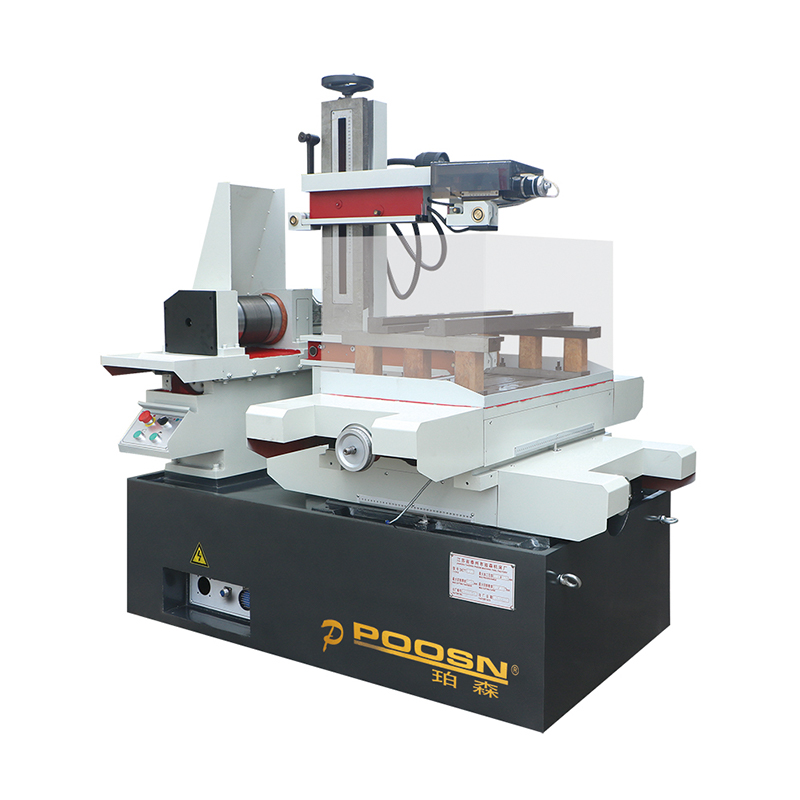 DK7745 High-Speed Wire EDM for Parting Lines and ToolingA cost-effective 4-axis high-speed EDM for parting lines, plate work and tooling, with 400×600 mm travel and efficient cutting.View Product →
Many shops pair a multi-cut medium-speed machine with a fast high-speed unit for looser work, and models such as the DK7745 remain a cost-effective second machine for parting lines, plate work and tooling. If you want to understand the manufacturer behind the machines, the company background and production history page covers the factory's experience in electrical discharge machining since the late 1990s.
Ask for a measured test cut on your drawing before you discuss price; a supplier who cannot produce one is selling a catalog page, not a machine.
Frequently Asked Questions About Wire EDM for Mold Making
Can wire EDM for mold making hold ±0.005 mm on a hardened insert?Yes, with the right combination: a multi-cut machine, a rough pass plus two or three trims, stable water temperature, conditioned wire and a fixture that does not stress the part. On a 50 mm hardened block, shops routinely achieve ±0.005 mm and reach ±0.003 mm when the room and the water are controlled. A single-pass machine will not get there regardless of operator skill. |
Which wire diameter should a mold shop run?0.25 mm brass or coated wire is the usual starting point for medium-speed mold work. Drop to 0.20 mm when internal corners or narrow slots demand it, accepting a slower cut and more frequent breaks. Go to 0.30 mm only when the geometry allows and removal rate matters more than corner sharpness. |
Is medium-speed or high-speed wire EDM better for mold making?They solve different problems. Medium-speed multi-cut machines own the insert work where fits and surface finish matter. High-speed machines with reciprocating molybdenum wire are faster and cheaper to run on plate openings, parting lines and tooling, where ±0.02 mm is acceptable. Most productive mold shops keep both rather than forcing one machine to cover both tolerance bands. |
How much stock should be left before the wire cut?0.2 to 0.5 mm per side is a healthy range after heat treatment. Less stock risks leaving mill marks or a decarburized layer that the wire cannot remove in one rough pass. More stock wastes multi-cut cycle time and increases the chance of distortion as internal stress releases during the cut. |
Does the recast layer affect polishing?It does if you leave it. A single rough pass leaves a recast layer of roughly 2 to 10 µm, which is hard, brittle and slow to polish. Trim passes reduce the layer to below a couple of micrometers and make the surface respond predictably to a polishing stone, which is why multi-cut pays back at the bench. |
What taper angle do mold shops actually need?Many injection mold jobs are covered by a few degrees, but die casting, glass molds and progressive dies often need 15 to 30 degrees, and some slide faces push beyond that. Buying 30 degrees with a stated thickness rating is a common balance; buying 60 degrees makes sense when the order book already contains deep angled work. |
How do I compare wire EDM machine price across suppliers?Normalize the quotation first: same table size, same taper rating with workpiece height, same number of trim passes, same accessory list, same commissioning and training. Then compare cost per finished insert using your own cycle times. A lower purchase price with no acceptance cut and weak spare parts support is usually the more expensive option over five years. |
Explore Further
These pages cover the practical next steps for shops planning mold and die work with wire EDM.
- Mold manufacturing industry solutions — how the machine series map to cavity, core and insert work.
- PS-C medium-speed wire cut EDM machine series — model range, specifications and multi-cut capability.
- Contact the factory — send a drawing and request a test cut, cycle time estimate or quotation.
A mold shop that treats work, wire EDM as a tolerance tool rather than a fast saw ends up with a different workflow. Tight work goes to the multi-cut machine with a documented pass sequence. Loose work goes to the single-pass machine at full speed. Taper is planned together with height instead of being discovered at inspection, and water, wire and guides are treated as consumables on a schedule rather than as surprises.
The result is not simply better parts. It is fewer bench hours, fewer re-cuts and a delivery date that survives contact with a hard insert. Whether you are comparing a first machine or adding a second, the useful question is always the same: what tolerance must this part hold, and what does the whole chain cost to get there?
A wire EDM is only as accurate as the process around it; specify the process you intend to run, and buy the machine that makes that process repeatable.
-
Phone
+86-0523-86268788 +86-13815960366 +86-13912191163Email
[email protected]Address
No. 366, Yusheng Road Jiulong Town, Hailing District Taizhou City, China
Copyright © Taizhou Xinchengyang Machinery Manufacturing Co., Ltd. All Rights Reserved.
Custom edm machine for sale
wholesale edm machine manufacturers
